
Technicals | Sep 02 2026

Earlier today, Tony Sycamore, Market Analyst, IG updated his views and thoughts on financial markets, including the technical analysis updates.
First Up, Nasdaq100
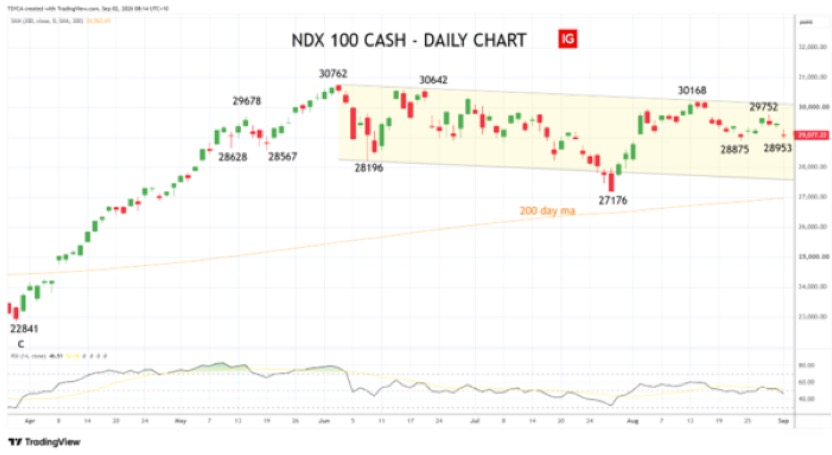
From its late-March low of 22,841 the Nasdaq100 launched a powerful 35% rally in just over nine weeks to reach a record high of 30,762 in early June.
The correction that followed into late July played out mostly as expected and in early August we declared the correction complete at the 27,176 low and shifted to a bullish bias — only for trend-channel resistance near 32,000 to cut the rally short in mid-August.
While the pullback from that trend-channel resistance was a setback, the view remains that as long as the Nasdaq100 holds above short-term support at 28,800ish expect a retest and break of the 30,762-record high.
Aware that a sustained break below 28,800ish would negate the short-term bullish view and open the way for a retest of trend-channel support now near 27,600.
ASX200
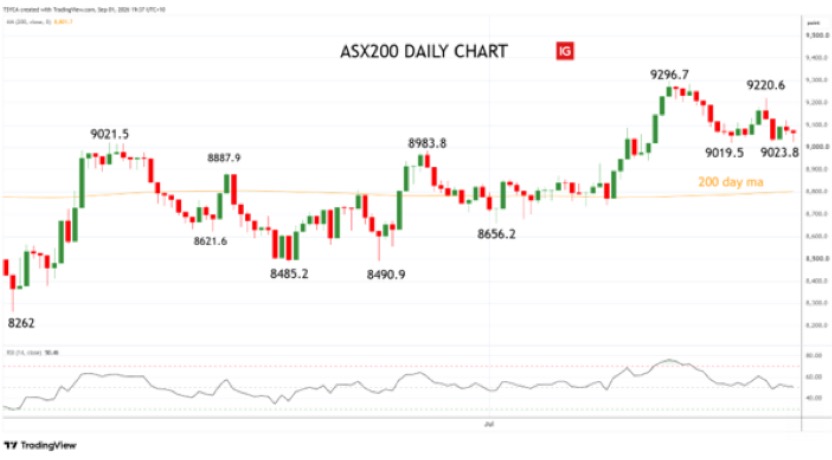
The ASX200 spent the better part of 17 weeks confined within an 8500–9000 range before releasing that pent-up energy at the start of August to hit a fresh record high of 9296.7.
From that high we were expecting a pullback towards 9000 and that view played out well with the index set for another test of that support region this morning.
Looking ahead, provided the ASX200 holds above the 9000/8900 support (former top of range resistance, now support) and the 200-day moving average at 8800, look for signs of basing before a retest and break of the 9296.7 record high in the weeks ahead.
Aware that a sustained break below 8800ish would indicate the ASX200 has returned to its former 8500-9000 range for a period of more range trading.
Crude Oil
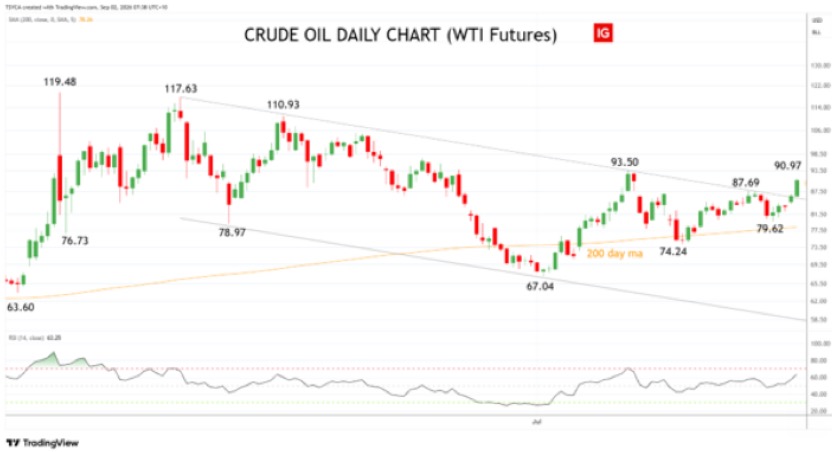
WTI Crude Oil finished higher overnight at US$90.68 (up 5.06%) its highest close in almost six weeks.
The bulk of those gains followed a fresh round of US strikes on IRGC targets, with the IRGC answering with ballistic missiles targeting US bases in Jordan.
While it remains to be seen how long this latest flare-up lasts, it is safe to assume that until there are firm signs of de-escalation, the flow of oil moving out of the Strait via dark-ship transits and ship-to-ship transfers etc will taper off sharply, aggravating already elevated supply-disruption concerns.
Technically, after yesterday’s break above trend-channel resistance, there appears scope for WTI to push toward the next upside target — the 25 July high at US$93.50.
Gold
Gold finished lower overnight at US$4328 (down -2.72%) extending its decline from the US$4697 high into hit last week.
Just five sessions from the August month-end, gold was up 15% for the month and on track for its best monthly performance since September 1999. A dual setback in the final days of August took some of the shine off, leaving it up a still-respectable 10% — its best month since January 2026.
The catalyst for gold rally in early August was renewed optimism that a diplomatic breakthrough in the Middle East was close. On 5 August Trump said talks had run all day and that “the Strait of Hormuz is going to be open very soon,” which would have meant lower oil prices and less pressure on central banks to raise rates.
Golds gains were added to in mid-August after the US Treasury said it would at least double the size of its long-term bond buybacks. That, combined with US national debt topping US$40 trillion, swiftly revived fiscal and credibility concerns and ushered back the “debasement trade,” pushing gold to a 15-month high of US$4697.
The fall from that point has been swift, with gold dropping around -US$300, or -6.3%, into Monday’s $4396 low.
The sell-off was sparked at the end of last week after Fed Chair Warsh sounded hawkish in his maiden Jackson Hole speech. He said the Fed’s 2% inflation target is non-negotiable, and that while recent PCE and CPI readings were better than expected, they do not confirm that underlying inflation trends have meaningfully improved.
That was followed by yesterday’s escalation in the Strait of Hormuz, which prompted a sharp rise in the oil price and revived inflation worries. The impact of those twin events has forced a hawkish repricing in the US rates market. There is now 18bp of hikes priced for the 16 September Fed meeting, with a cumulative 60bp priced between now and June 2027.
The rising chance of a hike in just over two weeks has undercut conviction in the debasement-trades revival and left the question of what comes next for gold. To that end, the path of the current flare-up in the Middle East will matter, as will two key data points: Friday night’s August non-farm payrolls report and next week’s August CPI.
What comes next for gold is largely dependent on the path the current flare up in the Middle East takes as well as two key data points: Friday night’s August non-farm payrolls report and next week’s August CPI.
Technically, Friday’s break below the 200-day moving average at US$4526 has done some short-term technical damage, but it has not changed the medium-term view that gold based at the late-June US$3942 low.
The preference remains to buy pullbacks, looking for a push toward US$5000.
All material has been re-published with permission and does not by association represent FNArena’s views.
Technical limitations
If you are reading this story through a third party distribution channel and you cannot see charts included, we apologise, but technical limitations are to blame.
Find out why FNArena subscribers like the service so much: “Your Feedback (Thank You)” – Warning this story contains unashamedly positive feedback on the service provided.
FNArena is proud about its track record and past achievements: Ten Years On