
Australia | Mar 11 2009

By Greg Peel
Everywhere about us is doom and gloom, and then more doom and gloom. There is a global financial crisis. It is possibly the worst since the Great Depression. The share market continues to collapse (except today). Unemployment is rising. House prices are falling. The government is very worried. The government suggests things will only get worse before they get better, so be prepared. In such a climate, the Australian consumer could be completely forgiven for losing more and more confidence.
But that is not the case.
The Westpac-Melbourne Institute index of consumer confidence – calculated through a sample survey – fell 0.2% this month to 85.6%. The number was enough for Westpac chief economist Bill Evans to suggest, “On the face of it, this is a surprisingly good result”.
The index works on the basis that the long run average might be considered “neutral” confidence and is marked at 100%. Anything above assumes high confidence – anything below assumes low confidence. Consumer confidence is a very important measure, despite being a mathematical interpretation of what is otherwise an intangible attitude. In the simplest of terms, if consumers are confident, they will spend (and perhaps borrow to spend). If not, they won’t. Despite all the complexities of a twenty-first century economy, the reality is that an economy will grow only if people spend money.
Consumer confidence is thus a very important “leading” indicator. It gives us an idea of what might happen ahead. A total lack of consumer confidence portends a contraction in the economy. The GDP number is a “trailing” indicator. It has the largely irrelevant capacity to tell us we have been in a recession for the past nine months. If things are going to get worse from here, it won’t simply be because they were bad before.
That doesn’t mean that confidence is not affected by recession talk, and clearly the first negative GDP result in eons is enough to knock the wind out of the consumer. Another negative result and there’s our recession – albeit looking back. And fear caused by one result is just as likely to mean the next one will have to be bad because we expect it to be and act accordingly. Yet there’s only three weeks left in this quarter before we’re already onto the next one. And we won’t know whether March was a negative quarter until the month of June. Not a lot of help really.
That’s why surveys of business and consumer confidence are important for economists. And that’s why Bill Evans is surprised by the 0.2% drop in the month of March. With all the dooming and glooming, he expected a much bigger drop. In February confidence fell by 9.6%.
There might be a bit of a lag effect here, Evans suggests. The February drop came despite it being the month in which the government announced a second stimulus package – More Pennies from Kevin. And more pennies targeted at a wider cross-section of the community than the previous one. It was also the month in which the RBA dropped the cash rate yet another 100 points to 3.25% – the lowest level since the Beatles toured Australia. Despite February being a month of doom and gloom as well, the Westpac team thought maybe the fiscal and monetary stimulus news might just counter shattered confidence to some degree. They were very wrong in this assumption.
So is March just a catch-up? Now that we know the pennies are about to arrive in the mail, and the RBA didn’t see any reason to cut further this month, have we picked up some of that lost confidence?
Maybe, says Evans, or maybe the index is now finding a base. Maybe we are reaching the nadir of our confidence crunch. Take a look at the graph (possibly not available if you are reading this story through a third party distribution channel):
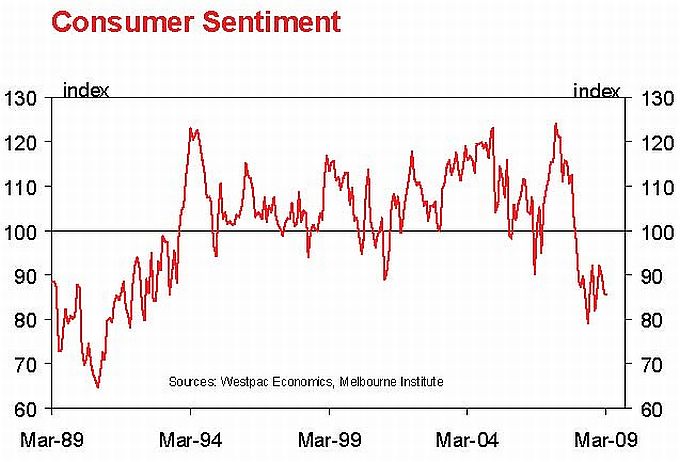
Note that the big collapse has been followed by consolidation. Any chartist will tell you that this upward-pointed flag is likely a precursor to another drop, unless it isn’t, in which case a break through those peaks will be a bullish signal. Chartists are good like that. But the numbers tell the tale.
Evans notes that the fall in Australian consumer confidence from March 2007 to March 2008 was 23%. The fall from 2008 to 2009 has only been 3.4%. Indeed, while confidence remains about 15% below average, it has been around that level since August. Between August and now, we’ve had 400 points of interest rate cuts.
Just how bad can confidence get? Well it’s there on the graph – look at 1992. And the graph tell us this recession could prove worse than 1992. But look at the biggest fall in confidence in one hit. It was the fall from the euphoria of early 2007 (when the stock markets were never going down again because of China) to the realisation in early 2008 that we were in trouble – big trouble. We have now been in trouble for about seventeen months. Can we actually become even less confident?
Within the data was another figure that surprised Westpac – the consumer’s five-year outlook surged by 15.2%, despite opinion on whether now is the right time to buy a major household item falling by 3.3%. In other words, suggests Evans, consumers may be of the opinion that things are bad now but the government is doing all it can to right the ship. It will just take some time. And that, incidentally, is exactly what the government is saying is the case.
As an indication of how consumers are responding to what we now all agree is a dreadful climate, 23.4% said this month the best use for savings now is to pay down debt and 32.8% said put it in the bank. There was still 21.7% who said invest in property or equity which, while now lower than the other options, suggests there is a proportion of the community who thinks there is value to be had at this level. Only 7.7% believed the best thing to do with savings right now is to spend them.
Which is not good news for Kevin.
Just as a point of interest, the Opposition leader has at least made one relevant point among his few lately which is backed up by the Westpac data. A lot of Australians are simply going to save their Pennies from Kevin (or pay down debt) rather than spend them, and that makes the stimulus package impotent. About 30% of the last package was retained, and that was Christmas. Perhaps the government could take note of what China has done.
The US$600bn stimulus package handed out by the Chinese government recently did not come in the form of cash. It came in the form of vouchers, exchangeable for goods.
Despite this apparent (but not assured) plateau in confidence as described by the Westpac data, Evans still believes the RBA will recommence rate cuts next month. Things just aren’t looking very good at all (wait for employment tomorrow) and thus the RBA will still need to ease again. The difference, however, is days of the shock-and-awe 100 point cuts are gone. Evans expects the next cut will be a return to the once standard 25 point movement. The RBA will be more conservative now that it believes it has made the necessary drastic reductions.
Evans does, however, still believe 2% will yet be the low in the cash rate. While this may seem like good news for mortgages, it implies the economy is only going to get worse from here, despite confidence perhaps looking towards greener pastures down the track.