
Book Reviews | Sep 04 2026

Edited extract from The one-page investing plan: Start simple, stay patient, build serious wealth by Scott Phillips (The Motley Fool).
The ETF mistake that’s quietly costing investors money
Stockbroker CommSec put out some data in late 2024 that showed the top-five investments traded by over 40s were all individual shares, while the top-five investments traded by under 40s were all ETFs.
There is something between an evolution and a revolution underway on the ASX. But not all ETFs are equal.
Some ETFs are wonderful. Others, in all likelihood, might just be bad for your wealth. Most investors who consider them think, ‘Trend A is strong and growing, and I think I could make money investing in that trend’.
That’s a perfectly reasonable starting point, too – something that’s growing and might be more popular in future is an indication that there might be something there.
But because you’re buying a whole basket of these things, here are some questions you probably should be able to provide a considered and grounded answer of ‘yes’ to:
- Is the trend real?
- Will the trend continue?
- Who will the trend make money for?
- Are those companies in this ETF?
- Is the ETF selling at an attractive valuation?
Example: The airline industry
If you’d have told me in 1975 that the number of airline passengers might climb from around 600 million to almost 10 billion 50 years later – a gain of 13 times – you would have conclusively, and accurately, answered the first two questions.
And I might have mortgaged the house, sold the kids and put all of the money into airline stocks.
The problem is that while air travel boomed, airlines did terribly. Woefully. Some went broke two or three times over that time.
The trend was real, but the benefit went to consumers as competition drove the cost of air travel lower.
Airports did okay, but airlines lost a fortune.
As Warren Buffett said: “if a farsighted capitalist had been present at Kitty Hawk, he would have done his successors a huge favor by shooting Orville [of Wright Brothers fame] down”.
Example: Lithium
Now let’s turn to, say, lithium. Is the trend real? Yes, so far. Absolutely. Will the trend continue? Probably, but that assumes battery chemistry doesn’t evolve away from lithium.
Who will the trend make money for? It’s hard-to-impossible to know. If more lithium is discovered and mined, that could keep a lid on prices, which would mean miners will be okay, but consumers will win.
Or maybe supply struggles to keep up with demand, and prices rise. Who knows? Even if you think it’ll be the latter, are those companies in a given lithium ETF? Maybe.
But you’d have to check each one to make sure, rather than assuming (Visa and Mastercard, for example, are in some ‘crypto’ ETFs!).
Is the ETF selling at an attractive valuation? How could you know, unless you work out which companies are in the ETF, and what their profitability and prospects were, and compare that to their prices, before adding it all up to see whether the ETF itself was attractive?
In other words, ‘Lithium demand is growing, so I should buy a lithium ETF’ might be just a little too simplistic, however exciting the ETF marketing material makes it sound.
The danger for your wealth
For that and other reasons, you might reasonably assume I’m pretty cool on these non-index-based ETFs. And you’d be right.
I’m not saying they could never have a place in a portfolio under certain circumstances, if and when an investor had done all of the above work.
But I am saying I reckon too many investors buy them without doing that work … and that makes them potentially dangerous for your wealth.
The low-cost, passive, index-based ones are still an absolutely great tool for investors, if they’re looking for the sort of hands-off diversification they can deliver.
A word of caution
I want to finish with a word of caution, though: Just because they’re diversified, doesn’t mean you can’t lose money from time to time when the whole market drops.
An ASX ETF didn’t prevent you from losing 38 per cent during the COVID crash. In fact, it was the opposite – because it followed the index precisely, it guaranteed you’d lose that much!
But it also guaranteed you’d benefit from the subsequent recovery.
Just don’t use index ETFs to save you from volatility – they won’t, because they’re not designed to.
And that’s a feature, not a bug, because if the market continues to create value and rise over time, those ETFs will grow in value, too.
And that’s what I fully expect them to do.
But well-chosen ETFs will provide you with low-cost simplicity and diversification – and that’s well worth taking advantage of, I reckon.
Edited extract from The one-page investing plan: Start simple, stay patient, build serious wealth by Scott Phillips (Wiley, $36.95), available from 1 September at all leading retailers.
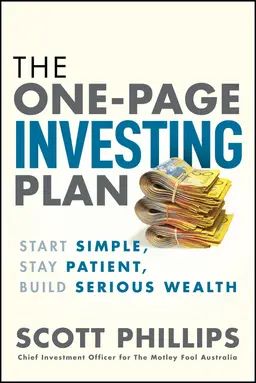
Technical limitations
If you are reading this story through a third party distribution channel and you cannot see the book cover included, we apologise, but technical limitations are to blame.
Find out why FNArena subscribers like the service so much: “Your Feedback (Thank You)” – Warning this story contains unashamedly positive feedback on the service provided.
FNArena is proud about its track record and past achievements: Ten Years On