
Australia | Feb 23 2007

By Greg Peel
Abacus Property Group (ABP) this month reported a solid result boasting a 58% increase in profit and is anticipating around a 6.6% yield for FY07. The only broker in the FNArena database to cover Abacus – Macquarie – rates the group as Outperform.
In December, Abacus launched the new Abacus Hospitality Fund to wholesale investors. This week the investment opportunity was extended to retail clients. FNArena was invited to attend a launch presentation.
Last reporting year, Abacus Property sold its Rendezvous hotel (previously “The Carlton”) in Auckland for A$99.9m, booking a profit of A$12.1m. Abacus held the property for a mere four months. Such a transaction seems an extraordinary one in property-depressed New Zealand, but the fact of the matter is that while housing and office prices in NZ and the east coast of Australia might be in the doldrums, hotel prices are quite the opposite.
The simple reason is that land values are still extremely high, particularly in places where one might wish to build a hotel. Add to that soaring building costs, and it quickly becomes apparent that building a hotel from scratch – anywhere in the country – has become a rather uneconomic proposition. Mike Batchelor, executive VP of hotel investment managers Jones Lang LaSalle Hotels, pointed out at the presentation that five star hotels now cost something like $700,000 per room to build, yet, as an example, the Four Seasons in Sydney sold last year for around $400,000 per room.
Yet occupancy rates in Australasian hotels have been growing steadily from the post-Olympic hangover, particularly as the Australian economy has boomed. Simon McGrath, VP of hotel management group Accor Australia, noted occupancy rates grew across Accor’s 100 hotels from 73% in 2005 to 76% in 2006. Unsurprisingly, hotels in mining areas are hitting 90% occupancy.
Hotels measure their success on something called REVPAR – revenue per average room – which is calculated as occupancy times average room rate. Because of increased occupancy rates, and a decline in new hotel construction, both sides of the REVPAR equation have been increasing. Accor’s average REVPAR grew by 11.2% in 2006. REVPAR growth in mining areas was as high as 35%.
The nature of hotel ownership has changed over the decades. While once establishments were owned and managed by the same party – be it an individual concern or a global chain such as Hilton – in today’s world hotels fall more and more under the platform model of twenty-first century commerce. A hotel is managed by a specific management company, such as Accor or Rydges for example, while ownership of the asset is separate and often the domain of property funds.
Another strong area of growth in hospitality has been in budget to mid-range accommodation. Whereas once there may have been a clear gap from your Travel Lodge motel-style for travelling salesman to your five-star, hot-an-cold-running-servants type colossus for the well-to-do, both holiday-makers and commercial travellers alike a turning to cheaper alternatives that offer little more than a clean room, a bed and a key, all in the right location.
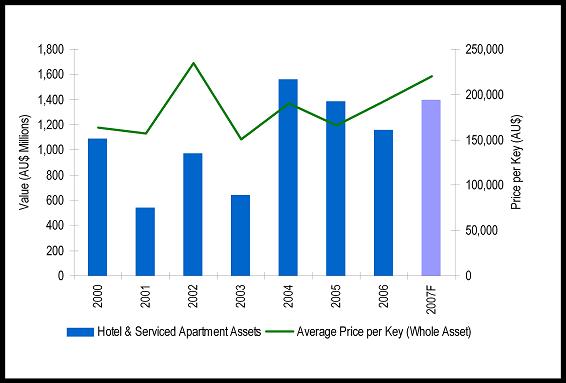
It follows that the average sale price per room (or per key, as they say in the trade) in Australia this year is predicted to retest $200,000. This compares to the aforementioned high-end mark of $400,000 for the five-star Four Seasons. While you couldn’t give away a hotel immediately after the Olympics, Australia’s economic surge resulted in a renewed surge in hotel acquisitions, at least up to 2004. In 2004, $1.6 billion in sales were recorded. That figure fell to $1.4 billion in 2005 and $1.2 billion in 2006 – not because demand diminished, but because supply diminished. As there are now fewer hotels on the drawing boards, it stands that REVPARs can only be in an upward trend.
Tourism is one of Australia’s leading industries but it is well understood to be a volatile game, with anything from disease outbreaks to terrorism or fuel prices causing demand shocks that require bikini girls to occasionally plead with foreigners to get the bloody hell over here. But tourist occupancy in Australian accommodation now runs at only about 50/50 with corporate visitors. Tourist shocks are not as dramatic as they used to be.
The obvious question is thus: what about corporate demand? Australia has ridden high on the commodities boom which may or may not last forever. Even Accor’s Simon McGrath admits “there is no doubting we are currently very high in the cycle”. But McGrath adds “we are optimistic that the upward trend will continue for the foreseeable future”.
It’s not about commodity prices, it’s about room supply. Says McGrath:
“What is different from previous upward cycles is that the positive results [increasing REVPARs] haven’t provoked a vast increase in room supply. In fact, it is very likely that the central business district of Sydney will go through the whole of this decade without a single new-build hotel”.
Does this sound familiar? As supply lags well behind demand, and barriers to entry are significant, is this the beginning of a hotel super-cycle?
I doubt whether Abacus Property Group’s managing director Dr Frank Wolf would be quite so hyperbolic, but there is no doubt he is enthusiastic about the launch of the Abacus Hospitality Fund – a vehicle he understands to be unique in Australasia.
The Abacus plan is to source funds to with the aim to accumulate hotel properties on the uptrend and strip out inefficiencies by retaining “highly experienced hotel managers” (such as Accor) thus maximising the capital return and yield potential to unit-holders.
“With an initial portfolio of approximately $134 million” said DrWolf, “Abacus is targeting a total return for investors of 10% per annum on invested capital after costs and before tax, comprising regular quarterly income of 8% and growth in the fund’s net asset value.”
The fund has kicked off with three properties under its belt – the Novotel Twin Waters, which is a holiday retreat acreage on Queensland’s Sunshine Coast; the Chateau on the Park, a four-star resort/conference destination on the edge of the Christchurch CBD; and Rydges Tradewinds, which is a refurbished high-rise hotel being one of few on the downtown Cairns waterfront.
“We believe the initial portfolio of these three hotel properties will provide an attractive yield for investors.
“Additional benefits for security holders include a high tax deferral, discounted accommodation at any of the hotels operated by the Fund Managers, and other benefits negotiated with our hotel partners.”
Abacus Property group will hold 10% of the fund, and provides the assurance of financial strength and funds management expertise.
There would be few financial analysts who would admit to correctly predicting the extraordinary share price run of listed property trusts and other yield vehicles on the Australian stock market over the past few years. Indeed, with interest rate pressures to the upside, it was not long ago that many a strategist was recommending underweighting such instruments. But with the sheer weight of global liquidity flying around the market looking for a home, it is easy to realise in hindsight that any yield is a good yield.
Macquarie analysts noted earlier in the month that Abacus Property Group’s (as opposed to the Hospitality Fund) projected 2007 yield of 6.6% (and 7% in 2008) appeared “compelling” compared to the now sector average yield of 5.4% and growth of 4.3%. Listed trusts that were once attracting investors with yields of 7-8% have proven to be gold mines for the lucky few who made their move earlier in the run. Now that entry points are reflecting significantly lower yields – moving closer to those of banks – the hunt is on for the next opportunity. It may be that in hotels, Abacus has hit on one of those opportunities.