
Australia | Mar 30 2007

(Due to technical restrictions this story will display without the graphs and charts included on some third party redistribution channels.)
By Greg Peel
Never pay in cash. Never tell the truth. Never play by the rules.
According to Bryan Burrough and John Helyar’s bestselling epic “Barbarians at the Gate”, these were the “rules” that governed the leveraged buyout assaults that hit Wall Street back in the late eighties. The most famous, and the subject of the book, was the 1988 US$34 billion takeover of food and tobacco giant RJR Nabisco. At the time, this was the biggest LBO ever undertaken.
The takeover consortium was led by a firm called Kohlberg, Kravis and Roberts, or KKR, which is credited with inventing the leveraged buyout. Sound familiar? KKR is still at it today, and notably so in Australia. It was KKR that initially took a swing at Coles, and by now the Coles board is probably wishing it had accepted the bid. That would have been the biggest takeover deal in Australian history.
The late eighties LBO boom ended around 1989 when many small US Savings & Loans firms crashed under the weight of junk bond investment. The junk bond was a favoured buyout financing tool of the eighties, in a time when interest rates were at least twice what they are now. Therein followed the global recession of the early nineties.
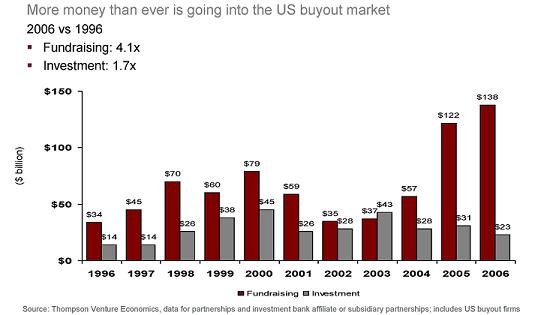
Until last year, RJR Nabisco remained the biggest ever LBO. That record has now been broken on more than one occasion, and last month saw the latest high-mark established with the takeover of US company TXU Corp by a consortium led by – you guessed it – KKR. The bid value was US$45 billion, of which 80% was financed by debt.
The biggest leveraged buyout in Australian history is currently on the table as Airline Partners Australia attempts to buy Qantas (QAN) for an enterprise value of $16.5 billion. The buying consortium includes the ubiquitous Macquarie Bank (MBL), US private equity specialist Texas Pacific (which joined KKR in the TXU deal) and local private equity specialist Allco Equity Partners (AEP).
Allco Equity Partners was established as a “listed cash box” in 2005 with an initial $550 million in funds. Traditionally, a “cash box” is a company that raises funds and then goes looking for investment opportunities. Specifically, Allco intended to focus on takeover targets. Allco lays claim to the first two hostile private equity takeover bids in Australia, in Veda Advantage (VEA) and Wattyl (WYL).
Last week FNArena was invited to attend a mergers and acquisitions conference hosted by IIR Conferences. Peter Yates was one of the presenters. This assessment draws upon the anecdotal and graphical information Yates was happy to impart.
M&A activity in Australia hit an all-time high in 2006, with deals such as the recapitalisation of PBL Media (PBL), the joint venture between Seven Network (SEV) and KKR, the mergers of Fairfax (FXJ) and Rural Press (RUP) and Suncorp (SUN) and Promina (PMN), and the unresolved $16.8 billion hostile takeover of Rinker (RIN) by Mexican company Cemex.
This represents some of the bigger deals, but there were plenty more across various industry sectors. Stock analysts have been forced to now assess each company on its takeover merit, as well as its standard valuation, in case someone comes along and bids a 35% premium for a struggler with a Sell rating.
2006 saw a leap in M&A activity above 2005 – the year that brought us Foster’s (FGL) acquisition of Southcorp, BHP Billiton’s (BHP) of WMC Resources, and Toll Holdings’ (TOL) of Patricks. In all, 100 listed company takeovers were completed in 2006.
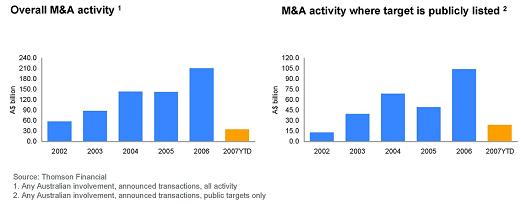
What is notable about the 2005 deals noted above is that they are “trade” takeovers. Each was one listed company taking over a similar listed company without enlisting any help from outside funds. The deals were pulled off without a “financial sponsor”. This is the buzzword term for the involvement of a private equity company within a consortium.
While Australian takeover activity has been rife recently, it was only last year that Australia caught up with the rest of the mature economic world in its level of sponsored takeover activity.
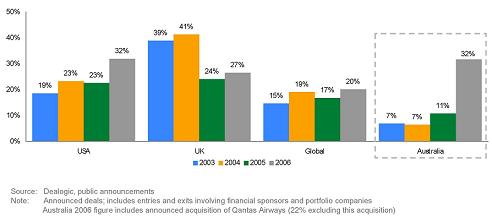
Why have sponsored takeovers of listed companies suddenly become so popular?
The simple answer is that there’s too much private cash around looking for a home. In the easy-money economy that has existed since the fallout from the dotcom boom, liquidity has been high, and traditional investments have been dull. Hence a rush to seek new investment opportunities in emerging markets, commodities, or anything that might offer above-average returns. This includes equity markets.
In the volatile period of the eighties that saw the 1987 crash of the stock market and of takeover kings such as Bond Corp, Bell Resources and Quintex, the invention of the LBO and subsequent junk bond frenzy, and the consequent “crashette” of 1989, interest rates were about twice as high as they are today. Listed companies learnt a lesson – don’t overgear.
Today, interest rates are much lower, and yet the average net “book gearing” of the ASX 200 is only 30%, while net “market gearing” (based on the share price) is a mere 11%. Australian companies are conservative. What this has meant, however, is that they have plenty of scope to acquire for growth.
In today’s bull market it is simply not enough for a company to grow organically. Stock analysts require double-digit earnings growth before they will get excited, and they will lambaste any company sitting on a pile of cash that isn’t out there looking for someone to swallow. It is a case of acquire or die. While excess cash earnings have led to a spate of share buybacks, they have also fuelled the latest M&A rush. And with Australian companies trading on higher price/earnings multiples than their offshore peers, the world has become Australia ‘s oyster.
Domestic consolidation and overseas expansion is being driven by the market’s current penchant to reward for growth rather than discount for risk. No takeover is without its risks (and in fact many a consolidation has been beset by integration problems for sometime after), but this pales into insignificance against the need to grow earnings. The market rewards companies for action (assisted by analysts who drive the perceptions).
Up for grabs is the ability to extract synergies in everything from employee levels to IT, from killing off competitors to securing distribution chains. Vertical integration cuts out the middleman. And the bigger the company, the lower the overall cost of capital.
But trade takeovers are of little help to wealthy privateers. While there have also been many “private treaty” takeovers in the unlisted market, large deals are limited and the game has become highly competitive. For those looking to make a return on their money, the listed market stands out glaringly. Enough privateers banded together become a potent force.
When it comes to who could make the most out of a takeover target, private equity has many advantages over listed companies.
Listed companies would dare not take the sort of gearing risks private equity is prepared to accommodate. With net levels at 30%, debt-backed takeovers up to 80% are just not in the ball park for the listed companies. They would be mercilessly slaughtered by analysts and the market if they were to contemplate such risks. Privateers have money to gamble.
Privateers are focused on the longer term – three to five years or more – when considering their investments. Listed companies are under the pump to produce earnings per share growth within at least 12 months. Every analyst focuses on the dilutive or accretive effect of an acquisition on EPS, even in the first year. Privateers focus on the internal rate of return that can be achieved over the longer time frame.
Privateers expect a “J-curve”. That is one where value is initially diminished but soon turns and fires up when rationalisation initiatives begin to bear fruit. Listed companies cannot afford to wear high initial costs or underperformance. Again, they will be slaughtered by analysts and the market. Privateers are not concerned about short term accounting. Listed companies have their short term accounting run up the flagpole for all to see.
Private consortia can work with management on an alignment of interests. Listed companies already run things their own way, and will move to impress their strategies and cultures upon a new acquisition, not always with success.
Those are some advantages private equity has over public companies. There are, however, disadvantages as well.
By definition, private equity cannot extract synergies from a company, as they’re bringing anything with them but finance. Private equity seeks to divest of underperforming assets and streamline efficiencies as a means of extracting value.
By law, a private equity consortium must achieve a 100% takeover of a target company in order to have affected the takeover. This particular point is in focus currently with regard to Qantas, where two minor shareholders have the power to completely stymie the deal. Trade takeovers, however, can result in the aggressor settling for a percentage of less than 90% of the target – perhaps less than 50%.
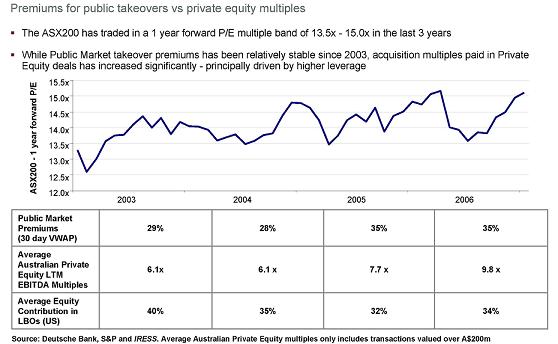
Thus it is no surprise that private equity is willing to pay premiums of 30-35% over market value in order to secure their targets. This is the sort of magnitude required to force shareholders to think long and hard. But Qantas is a case in point of where the takeover premium may never be enough.
In a world where opportunities are becoming increasingly more thin on the ground, an investor such as UBS or Balanced Equity has to consider any takeover offers as a case of “where will I put the money otherwise?” If an investor is enjoying strong cashflows and solid earnings growth, and is confident that both will continue into the future, is a 35% premium even worth a look?
This is the problem the private equity is now facing. In a world where everything is a potential target, suitors bearing trinkets are not welcomed with ingenuous fascination. This would tend to suggest that private equity bid premiums must have been growing along with the level of activity in the market.
This is not actually the case. Takeover premiums have not leapt materially. What have changed are the quality of the target company and the level of debt financing. As the table below shows, private equity has been prepared to pay higher and higher implicit price/earnings multiples, while increasing the level of debt finance.
The question is thus: is this a bubble about to burst?
Peter Yates expects recent levels of takeover activity to continue in the foreseeable future. One would probably not expect the leader of potentially Australia ‘s largest takeover to date to believe anything much different. But Yates is not totally incapable of circumspection.
There are, however, reasons why private equity activity now differs from the boom of the eighties.
While it would be foolish to suggest private equity is not motivated by the desire for increased wealth (greed is good) there is a difference today, Yates suggests that private investors are not looking for the get-rich-quick, one-off, life-changing deal. They do not expect to takeover one company, sell it quickly at a profit, and retire forever.
As noted earlier, privateers expect to ride the J-curve. There is a greater recognition, says Yates, that cycles end, and there is a greater ability to wait for the rebound. Commitment is long term, not fly-by-night.
Yates also makes the point that funds are better diversified today than they were back then. GSJB Were COO Craig Drummond expanded on this and other arguments when talking to The Age back in December:
“In the 1980s, it was a relatively narrow group of bank-funded entrepreneurial groups. Today, it’s a lot broader [in terms of] both the acquirers and the companies. The other issue is that the corporate and economic fundamentals remain quite robust, and again it’s somewhat different in the 1980s,” Drummond says.
“In the past we have seen one or two sectors alight, but here we’ve got [activity] from financial services, to infrastructure through to transport, health care … It seems to be very broad-based corporate activity at this time … If you go back to 1986-87, when there was also significant corporate activity, it’s quite different now.
“One: the private equity phenomenon is more prevalent. Two: corporate balance sheets are still considerably less geared than they were at that point in time. Three: we are seeing more genuine cash flow in pension funds. But also because of stock buybacks, large dividend payouts and the amount of corporate activity we are seeing, we are seeing a lot of that cash going back into the market or back into corporates.”
There they are, those magic words – “this time it’s different”. Many an investor or economist has come unstuck by daring to speak such a taboo. Yates agrees, suggesting there is a need to be concerned about a creeping “this time it’s different” mentality. The best PE deals occur in an economic downturn, notes Yates.
This is not an economic downturn. (Yet)
How long can the bubble – if it is a bubble – last? On the side of private equity are some revealing statistics. The corporate debt to equity ratio has fallen from 169% in 1990 to 71.7%, and debt is 380% of corporate profits today compared with 530% in 1991. This would tend to suggest there is still plenty of upside in the private equity rush. There is also no lack of risk-hungry money across the globe, searching for a home.
But as the Shanghai Surprise warned us, when it comes to risk, investors can soon turn love into hate.
Watch those multiples.