
International | 10:30 AM

Fed hiking anxiety has taken a big step back as US equities sold off and funds flowed into US Treasuries instead, pulling the US ten-year yield back below 5%.
Equity Shocks Override the Hawkish Fed as the 10-Year Treasury Yield Falls Below 5%
The following article is contributed by Pete from Weekly Market Reports, an independent macro research publisher.
For much of November, the US Treasury market appeared locked into a straightforward narrative of persistent inflation and aggressive monetary tightening.
That narrative shattered in the week ending November 20, 2026.
Rather than climbing higher on central bank rhetoric, bond yields reversed course as an equity sell-off triggered a powerful flight to safety, dragging the benchmark 10-year yield back below the psychological 5.00% barrier to close at 4.92%.
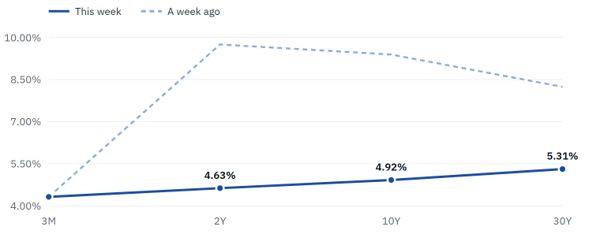
Chart 1. The US Treasury yield curve, this week against a week ago. Source: Weekly Market Reports.
This rapid reversal reveals a shifting balance of power in fixed income.
While policymakers remain focused on price stability, bond traders are increasingly treating the yield curve as a barometer for financial stability and late-cycle economic fatigue.
When risk assets stumble, safe-haven demand now easily overwhelms hawkish interest rate projections.
The Inflation Setup and the Hawkish Peak
Earlier in the month, economic releases gave bond bears plenty of ammunition.
October headline CPI rose 0.4% month-over-month against a 0.3% consensus, while core CPI climbed 0.3%. Producer prices were even more jarring, with PPI reaching 6.5% year-over-year, the highest reading since November 2022.
Alongside solid growth figures—including third-quarter annualized GDP at 3.4%, October nonfarm payrolls adding 165,000 jobs with unemployment at 4.1%, and October retail sales rising 0.2% month-over-month (0.6% ex-autos versus 0.4% expected)—the data pointed toward an overheating economy.
Federal Reserve officials responded promptly. Governors Christopher Waller and Lisa Cook advocated for faster or larger rate increases, with Cook warning on November 20 against falling behind the curve.
By mid-November, CME FedWatch odds of a December 9 rate hike reached 93% to 100%. Trading Economics noted on November 16 that futures priced a 92% probability of a 25-basis-point increase and an 8% chance of a 50-basis-point move.
The Treasury curve initially absorbed this repricing through a sharp bear-flattening. The 2-year yield jumped from 4.46% on November 5 to 4.88% on November 13, a surge of 42 basis points. By November 13, the 10-year yield had climbed to 5.15%.
Even on November 18, following Waller’s call for aggressive policy action, CNBC reported the 2-year yield at 4.80%, the 10-year at 5.064%, and the 30-year at 5.408%.
When the AI Trade Cracks, Bonds Rally
The hawkish momentum hit a wall as instability emerged in the technology sector.
A wave of negative developments—including the exit of Nvidia’s CEO, new US chip export rules, SEC scrutiny, and a weak debut from Anthropic—sparked a broad sell-off across equities and AI infrastructure plays.
Investors rotated out of stocks and directly into government debt.
The resulting rally at the front end of the curve was historic.
Daily Treasury data shows the 2-year yield tumbled 25 basis points over the week from 4.88% on November 13 to 4.63% on November 20—a weekly decline of 5.12% and the steepest weekly drop since August 2025.
The 10-year yield dropped 23 basis points over the same period, falling 4.47% on the week to settle at 4.92%, after having closed above 5% on 29 sessions earlier in the year.
Meanwhile, the 3-month bill remained anchored at 4.32% with a 0.00% weekly change, narrowing the 3-month/2-year spread from 56 basis points down to 31 basis points.
Across the 2-year, 5-year, and 10-year maturities, yields fell by an average of roughly 24 basis points over the trailing week. That sudden rush into duration erased the premium built on 50-basis-point hike speculation.
Following pushback against a half-point move from Fed officials John Williams and Austan Goolsbee, combined with the equity tremor, markets wiped out the odds of an oversized hike and scaled back broader tightening bets to price only a standard 25-basis-point move in December.
Late-Cycle Signals in the Slope
Beneath the weekly volatility, the broader trajectory of the yield curve highlights mounting concern over how much tightening the economy can absorb.
While the 2-year/10-year spread widened slightly from 27 basis points on November 13 to 29 basis points on November 20 in a mild bull-steepening, that slope remains heavily compressed compared to roughly 74 basis points in early February and 53 basis points in August.
Several market observers view this multi-month flattening as a classic late-cycle warning. Economist David Rosenberg estimates that recent tightening in financial conditions already equals roughly 150 basis points of Fed hikes.
At the same time, credit stress is becoming visible in riskier debt segments, with CoreWeave bond spreads near 1,062 basis points and CCC-rated credit spreads around 1,353 basis points, alongside weakening commodity prices.
At the long end of the curve, however, yields are proving somewhat stickier. The 30-year yield fell 2.93% over the week to 5.31%, a noticeably slower descent than the belly of the curve.
Consequently, the 10-year/30-year slope widened from 32 basis points to 39 basis points. Sticky structural inflation and ongoing fiscal supply concerns continue to keep term-premium pressure on thirty-year bonds, aligning with analysis from Bond Vigilantes suggesting that long yields have less room to fall than short yields during an economic downturn.
Looking at the bigger picture, the 10-year yield has swung from near 5.00% in late October down to 4.84% in early November, up to 5.15% at mid-month, and back to 4.92% on November 20.
Although the entire curve from the 1-year to the 30-year maturity sits lower than it did one month ago, yields remain structurally higher than they were a year ago.
Still, last week’s price action delivered a clear verdict: when equity markets falter, Treasury buyers are far more worried about an oncoming slowdown than one more quarter-point rate hike.
Pete writes for Weekly Market Reports, an independent macro research publisher; its weekly Yield Curve report is free at weeklymarketreport.com/yield-curve.
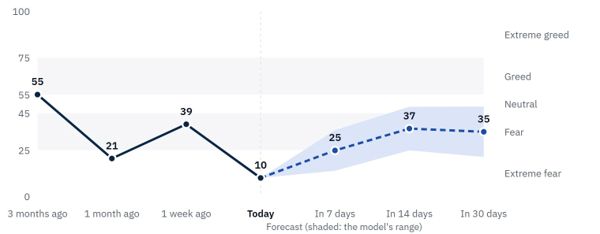
Chart 2. Our Fear & Greed index: the reading and the model’s forecast. Source: Weekly Market Reports.
Technical limitations
If you are reading this story through a third party distribution channel and you cannot see the two charts included, we apologise, but technical limitations are to blame.
Find out why FNArena subscribers like the service so much: “Your Feedback (Thank You)” – Warning this story contains unashamedly positive feedback on the service provided.
FNArena is proud about its track record and past achievements: Ten Years On
FNArena content is produced by real people. We use AI tools to assist with grammar checks, research verification and internal processes. Our experienced editorial team follows financial markets closely, identifies valuable insights from research reports and retains full responsibility for editorial decisions and published content.