

Rudi's View | May 14 2026

This story features JUDO CAPITAL HOLDINGS LIMITED, and other companies.
For more info SHARE ANALYSIS: JDO
The company is included in ASX200, ASX300 and ALL-ORDS
The outlook remains positive, global equity strategists maintain, though Australia will be among the world's laggards.
By Rudi Filapek-Vandyck, Editor
Consumers worldwide are feeling the pain from higher oil prices, as also witnessed in recent market updates by ASX-listed companies, but economic recessions should still be avoided as the positives from a cyclical upturn and significant spending on AI infrastructure provide plenty of offsets.
In contrast with prior oil price shocks, corporate earnings in key regions are accelerating, not shrinking, creating a positive undercurrent against today’s headwinds and uncertainties.
To illustrate their ongoing positive outlook, strategists at Morgan Stanley have raised their next twelve month’s target for the S&P500 to 8300, implying yet another year of double-digit return (11.5%) is most likely.
Jeff Schulze, head of economic and market strategy at Franklin Templeton’s ClearBridge Investments, is equally positive on the outlook for equities in the US (and worldwide).
Schulze is the author behind ClearBridge’s US Recession Dashboard which as at the end of April is hardly flashing any warning signals.
In fact, there are fewer warnings now than at the end of December, indicating the US economy is progressing into stronger underlying momentum, despite war in the Middle East and vulnerable consumers exposed to higher fuel prices.
Solid US Momentum
Schulze is currently visiting Australia to communicate ClearBridge’s strategy and insights to local investors and the media. Morgan Stanley just updated its prognostications for the six months (and more) ahead.
In the US specifically, positive stimulus from the One Beautiful Big Bill (OBBB) in combination with ever-larger spending on the build-out of AI infrastructure are seen as compensating for oil price pressure on consumer spending and corporate reluctance elsewhere.
Morgan Stanley, which is among the perma-bulls on Wall Street when it comes to the positive effects from AI, would argue the corporate sector (globally) is yet to experience the real benefits from AI adoption, which should add another boost to margins, and thus to profits and valuations.
Schulze’s outlook is less AI-centric, but equally constructive. He too suggests investors worrying about AI ‘bubbles’ and industry overspending are at least a couple of years too early.
Both agree there are now opportunities among sold off share prices in software companies and the like, on the assumption investors can separate future Winners from AI Losers.
Schulze’s outlook revolves less around US large caps, as several forces seem to be lining up for a catch-up by smaller caps and equities outside of the US, more specifically in Emerging Markets like China, South-Korea and Taiwan, where AI benefits are expected to keep accumulating.
Cheaper valuations are the extra bonus, plus the prospect for a weakening US dollar.
The Future Is Not The Past
While still constructive on US equities overall, Schulze warns investors should not extrapolate the past 15 years into the future. This applies to the Megacaps that have grown ever so strongly over that period, as well as the relative outperformance of US markets generally.
Historical data analysis suggests when index concentration reaches as high as it currently is, companies that make up the Top 10 are destined for relative underperformance.
This does not by default equal negative returns from yesterday’s Champions, just that better returns are on offer elsewhere (from stocks and markets that previously could not keep up).
The macro view is the US has now experienced 15 years of global market leadership, about the same length as the period late-1980s into the early nougthies, with a weakening US dollar signalling a time is arriving for leadership to shift outside of US markets.
The thesis of a ‘broadening bull market’ has been put forward by strategists since last year and recent indications, including the March quarter results in the US, are showing yesteryear’s laggards are catching up with the Mag7 and the broader technology sector.
In Australia, this has almost exclusively occurred through cyclical mining companies and energy producers, and companies directly linked to both market segments.
Both Morgan Stanley and Schulze believe the commodities revival has further to run.
Years of underinvestment are now colliding with rising demand from defense spending, resources nationalism, the AI build-out and a cyclical upswing while capex cycles require many more years before additional supply can be added into the mix.
Australia, The Laggard
The sad observation is Morgan Stanley has identified Australia for rather subdued economic growth this year and next.
Hence why the local market has been relegated to the less promising basket, together with South Asia, most countries in Latin America, and most of the EEMEA region.
Morgan Stanley is much more constructive on Japan, North Asia, Brazil, Greece, Hungary, and Saudi Arabia.
In terms of segments and sectors, Goods are preferred over Services, with explicit focus on Energy, Materials, Industrials, Semiconductors and Memory.
Have been placed in the unattractive basket: Autos, Consumer stocks, IT services, and downstream industries impacted by higher commodity prices.
Among the positives that support a constructive outlook, ClearBridge’s data analysis suggests whenever corporate profits grow above 9%, index returns tend to be above average.
Market consensus in the US is currently projecting 17% EPS growth in 2026.
Historical analysis equally shows investing during periods of heightened US political uncertainty (similar to the present) tend to end with superior equity market returns as soon as clarity is restored.
AI is most likely to augment jobs and to result in the creation of new jobs, rather than simply create mass unemployment (both ClearBridge and Morgan Stanley agree on this).
The US consumer is significantly less impacted by higher energy prices than in the past, with the average household in 2026 only spending 3.7% of its budget on fuel compared with 9% in 1980 and still 6%-plus during the GFC.
And while there will be more defaults forthcoming in US private credit, that segment is many times over smaller than Mortgage-Backed Securities (MBS) lending during the GFC, and not large enough to create problems that cannot be managed, in Schulze’s view.
Potentially adding to Australia’s woes is there seems to be a growing view in the market that the local banks still look overpriced when the economic outlook doesn’t look that flash.
From UBS’s banking sector team: “Current sector multiples don’t yet fully reflect a sector in transition, in our opinion, moving away from a benign credit and interest rate tailwind environment to one of rising provisions, slowing mortgage growth and policy adjustments.”
UBS’s reshuffled sector ranking is now (in order of preference): Judo Capital ((JDO)), National Australia Bank ((NAB)), Bank of Queensland ((BOQ)), Westpac ((WBC)), Macquarie Group ((MQG)), ANZ Bank ((ANZ)), then CommBank ((CBA)).
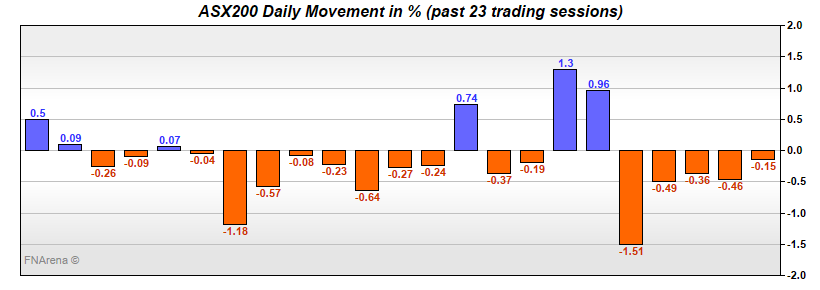
The below probably summarises Australian investors’ frustration this month in one simple, straightforward graphic:
One important note needs to be made against all of the above: everything you just read is subject to the opposing parties in the Middle East figuring out a sustainable solution that includes the re-opening of the Strait of Hormuz.
The fact US equities have taken the luxury of zooming in on the AI boom and largely ignoring the risks that might still erupt from the Middle East might serve as indication just about everyone, including Morgan Stanley and ClearBridge, assumes a solution between Iran, the US and Israel will be found.
Sooner rather than later is preferred.
See also:
https://fnarena.com/index.php/2026/05/13/rudis-view-ai-is-making-a-come-back/
https://fnarena.com/index.php/2026/05/07/rudis-view-the-times-they-are-a-changing/
https://fnarena.com/index.php/2026/05/06/rudis-view-ai-the-great-market-divider/
https://fnarena.com/index.php/2026/04/30/rudis-view-stagflation-no-recession/
FNArena’s Corporate Results Monitor: https://fnarena.com/index.php/reporting_season/
My curated lists via the All-Weathers segment: https://fnarena.com/index.php/analysis-data/all-weather-stocks/
(Do note that, in line with all my analyses, appearances and presentations, all of the above names and calculations are provided for educational purposes only. Investors should always consult with their licensed investment advisor first, before making any decisions.)
P.S. I – All paying members at FNArena are being reminded they can set an email alert for my Rudi’s View stories. Go to My Alerts (top bar of the website) and tick the box in front of ‘Rudi’s View’. You will receive an email alert every time a new Rudi’s View story has been published on the website.
P.S. II – If you are reading this story through a third party distribution channel and you cannot see charts included, we apologise, but technical limitations are to blame.
FNArena Subscription
A subscription to FNArena (6 or 12 months) comes with an archive of Special Reports (20 since 2006); examples below.


Find out why FNArena subscribers like the service so much: “Your Feedback (Thank You)” – Warning this story contains unashamedly positive feedback on the service provided.
FNArena is proud about its track record and past achievements: Ten Years On
Click to view our Glossary of Financial Terms
CHARTS
For more info SHARE ANALYSIS: ANZ - ANZ GROUP HOLDINGS LIMITED

For more info SHARE ANALYSIS: BOQ - BANK OF QUEENSLAND LIMITED
For more info SHARE ANALYSIS: CBA - COMMONWEALTH BANK OF AUSTRALIA
For more info SHARE ANALYSIS: JDO - JUDO CAPITAL HOLDINGS LIMITED
For more info SHARE ANALYSIS: MQG - MACQUARIE GROUP LIMITED
For more info SHARE ANALYSIS: NAB - NATIONAL AUSTRALIA BANK LIMITED
For more info SHARE ANALYSIS: WBC - WESTPAC BANKING CORPORATION