Australia | Oct 15 2008

By Greg Peel
Apart from the elements of the announced Australian government stimulus package discussed in Part I of this article, the package also included a doubling of the government’s first home buyer’s grant to $14,000 for an existing home, and a tripling to $21,000 for a newly constructed home, for houses bought before June 30, 2009.
Westpac’s Bill Evans notes that when the Howard government enacted a temporary doubling of the grant in 2001 for newly constructed homes, first home buyer housing finance approvals jumped 35% in four months, boosting total approvals by 7.3%. The boost lasted only as long as its temporary availability, and the subsequent slump in approvals that followed meant the numbers did not recover again until 2005-06.
Over 2001, the RBA’s cash rate dropped from 5.75% to its nadir of 4.25% following the tech-wreck and then 9/11. We had a mild recession in 2002. So the circumstances have a certain resonance, although mortgage rates are much higher this time given the 75 extra basis points Australian banks have increased above policy movements.
But aside from higher rates now, 2001 also marked the year that Australian house prices started heading to the moon. The grant may have provided a bit of a kicker, and the 2000 Olympics a lot of overseas interest, but it was cheap debt and lax lending in ensuing years which provide us with the following graph:
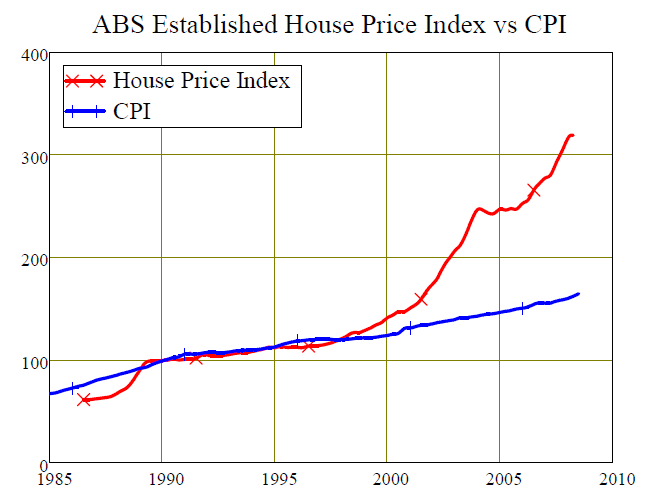
So clearly we are starting from a very different position than we did in 2001. Bill Evans notes that interest rates and house prices are significantly higher now, and the availability of housing finance is likely to be a lot more constrained. “However, it’s reasonable to expect the policy to have a broadly similar pull-forward effect on first home buyer demand,” Evans suggests.
Which means house prices in Australia must start rising again. Or does it?
The above graph is provided by Dr Steve Keen, professor of economics and long term FNArena correspondent, who has recently earned more notoriety by appearing on the 7.30 Report and single handedly boosting consumer spending on razor blades. Longer term readers of FNArena will know that Dr Keen falls into the uber-bear camp.
If there is one element of the current asset value crisis that has polarised economists and journalists alike it is that of Australian house prices. Some say up, some say down.
As recently as Monday – before the government’s stimulus package was announced – ANZ’s chief economist Saul Eslake released a report entitled “Australian house prices – unlikely to fall…”. The suggestion that Australian house prices may be about to fall follows simple logic, which is neatly summed up in the graph above. We are on the cusp of a recession, it is a global phenomenon, house prices in the US have collapsed, house prices in Britain are collapsing, house prices in other parts of Europe are collapsing, and we are no less guilty of debt-binging these last few years than anyone else.
To that end Dr Keen is predicting Australian house prices to fall 40%, and Morgan Stanley’s Gerard Minack is on record as tipping 50%. At the very least, the “house prices must fall” school is generally tipping 20%.
Eslake doesn’t agree. He bases his arguments on “important difference between the Australian and American housing and mortgage markets”.
Firstly, in its cheap-money debt binge the US went ahead and built a lot more houses than demand dictated. The situation is opposite in Australia where there has been a long term shortage of housing, more recently exacerbated by record immigration.
Secondly, while oversupply has reduced house prices in the US, the real pressure is coming from mortgage foreclosures. In the US, mortgage loans are “non-recourse”, meaning a delinquent owner can simply walk away if the house if the price has fallen below the mortgage value and the bank has no recourse to claim the difference against that owner’s other assets or income. Hence the popular “jingle mail”, where banks receive front door keys and nothing else. Banks do have recourse in Australia, and hence the underwater owner is unlikely to sell if all else is lost. In either case, foreclosure sales are not in the interest of banks and they will do all they can to work out some sort of loan rearrangement.
That’s one reason why Australia’s default rates have remained “vastly lower” than American ones, Eslake notes. He also notes, as is oft pointed out, that the infamous “subprime” mortgages available in the US which made up some 15%, while in Australia the closest thing to subprime – the “non-conforming loan” – makes up only 1%. If you can compare Australia’s “lo docs” and “no docs” to the US Alt-A’s then they have 15-20% of these “mid-prime” loans and we have only 7%.
To top it off, while the Fed held its funds rate at low levels (as low as 1%) for a long time following 9/11, thus perpetuating “free money”, the RBA was quick to start raising its cash rate from the 4.25% low when the boom began.
Eslake argues that the only way house prices can fall precipitously is if homeowners “have to sell them for whatever price they can get”, and that is not currently happening in Australia. Nor does Eslake believe it will happen ahead, but he does add the “important proviso” that this is the case only if unemployment does not spark sharply as it did in the 1990s”.
It is more likely, Eslake believes, that Australians wanting to sell will look at the market, see a lower price, and decide to hang on. Thus prices cannot cascade downwards.
For the record, Eslake does not believe unemployment will spike, nor does he believe we are facing a “deep and protracted recession”. He does believe, however, that there will be pockets of noticeable house price declines – in the infamous mortgage belt of “Western Sydney”, in premium suburbs where incomes were stretched, and in areas with a large proportion of investment properties. Nevertheless, he sees house prices on average staying around about where they are now for some time.
As noted, that was before the government’s stimulus package was announced. CommSec’s Craig James welcomes the government’s move to boost housing construction with its $21,000 grant for buyers of new homes. The housing construction industry had been wallowing in Australia despite an undersupply of dwellings, given soaring material costs, soaring labour costs, and a soaring cost of credit, all of which have now turned.
The expectation is that a whole new batch of those Legoland satellite suburbs will now pop up like mushrooms overnight. “Australia’s population is growing at the fastest rate in almost 20 years,” notes James, “but construction hasn’t been keeping pace. The incentives for first home buyers to build new homes or buy newly-erected homes represents a major and much-needed boost for house construction”.
Note that James neglects to heap praise on the increased grant for first buyers of existing homes. One possible reason is that this was a completely stupid policy under Howard and hasn’t lost any of its stupidity under Rudd. Giving every first buyer of an existing home another seven grand just means all house prices adjust upward by that amount, grossed up for lack of tax. It’s as good as a zero sum game. Existing houses remain just as unaffordable for first home buyers and the only winners are the sellers, who will use the money to pay down their loan.
This is a common complaint from commentators on the stimulus package. While the extra fourteen grand for newly built houses has the same effect on prices, it does provide new supply of houses as an offset. The Australian housing bubble of 2001-07 was driven almost entirely by existing houses changing hands at ever higher prices as extensive debt became more accessible to lower and lower income earners. Throw in greed, and the fear of “missing the market”, and we have a classic bubble.
Those bubble prices are still largely with us, yet the stock market has fallen 40%, commodity prices (the driver of Australia’s great income boom) have collapsed, credit is now a lot harder to find, lending margins over the RBA rate are much higher, and we are facing global recession. And despite the money the government is wasting in a vain attempt to restart non-bank lending, securitisation markets for cheap mortgages are dead and will be dead for a lifetime.
The belief that the lack of supply of housing in Australia will push house prices up is a myth. This lack of supply has nevertheless lead to a sharp jump in rental prices – the so-called “rental crisis” – but predictions from the likes of BIS Shrapnel that rents in Australia will ultimately rise an average 50% are just ludicrous.
Rents in the “better” suburbs have already begun to come down, and were before this last leg of the financial crisis began. This is because of what I call the stone- in- the-pond effect. If a landlord puts the rent up in a salubrious suburb above what someone who can’t afford to buy in that suburb can pay, that tenant will simply move one or two suburbs back down the scale.
Tenants in such less salubrious suburbs will then be forced out by these slightly higher-income earners paying higher rents, and so they will up and move further down the scale as well. If you rent because you can’t afford to buy, then how can you suddenly afford more rent? All you do is keep moving down and moving down to maintain the rent level you can afford, or move out of the city altogether. Just like ripples emanating from a stone dropped in a pond.
Just as an observation, the two-bedroom, tarted up but original Federation cottage next door to me has been available to rent for a week, but no one has chosen to inspect it as yet. I won’t tell you where I live, but let’s just say I nearly fell over when I heard they wanted $600pw. I think the bell has been rung. For one thing, the boost in construction about to arrive will release the pressure valve on rents, or so economists suggest.
And on the subject of moving out of Sydney or other expensive capital cities altogether, prospective buyers are leaving in droves. They are being replaced by new immigrants, but are all these people brain surgeons? Barristers? Movie stars? I thought they were “skilled tradesmen”. Somehow I can’t see these foreign tradesmen actually earning higher incomes than the resident tradesmen who can’t afford the current house prices.
I do see mass retrenchments yet to hit the local banking and broking fraternity however, a sudden turnaround in the “name your price” mining labour market as marginal mines go bust or shut down indefinitely, and a growing reluctance by a whole army of baby-boomers to spend any money buying anything unless it’s absolutely necessary, having just lost half their wealth.
In short, I agree with Saul Eslake that housing prices in Australia will not rise but I disagree that house prices cannot fall. I can only look back to that graph.
But wait – we have the new grant increases. Clearly this must imply some immediate upward pressure. Over to Dr Keen:
“Boosting the First Home Buyers Grant is a mistake, just as it was when Howard did it. It will merely delay the day of reckoning.”
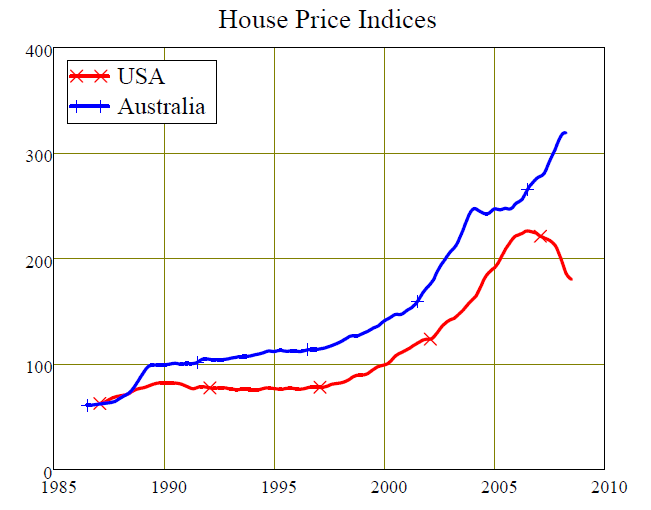
For as Dr Keen points out, despite all the differences pointed out by Saul Eslake with regard to US and Australian mortgage markets, the fact is, on a relative basis, Australians have have increased their household debt by much more than the Americans did this last few years and pushed house prices much higher to boot.
Exhibit B: