
International | Dec 19 2025

The development of humanoid robots is moving more mainstream, yet the household deployment could be 20-years away
- Mapping a US$25trn robotics future
- Ai moves from the digital to physical world but questions rise on safety, cost & efficacy
- Industrial humanoid trials are being rolled out in real world examples
- China accelerates deployment, with the US and Europe seeking to catch up
- Are we witnessing the next industrial revolution or inflating the next great bubble?
By Danielle Ecuyer

A total addressable market in the trillions spurs innovation
Shush, are you listening?
“Every great advance in science has issued from a new audacity of imagination.”
That statement is from John Dewey, a major American philosopher, psychologist, and education reformer who lived from 1859 to 1952.
Can you imagine a world re-imagined with humanoid robots fulfilling daily household tasks, with adjacent robotic capacity that transcends across most industries and countries?
Major US investment banks are at the forefront of research deep dives on what they believe is the start of such enormous change that history books will be written about this period.
At the core is artificial intelligence and the ability for the technology to transcend from the digital to the physical world. Think autonomous driverless vehicles, drones and human-like robots, i.e. humanoids.
Morgan Stanley initiated the Global Robotic Model (GROM) that creates bottom-up models across every industry, region and sector to illustrate how the global robotics market might evolve and grow by 2050.
Applying current global statistics, Morgan Stanley highlights the global labour force stands at 4 billion people. Assuming a US$10k per person annual wage, this equates to a US$40trn value or just over one-third of global GDP.
The broker estimates the AI robotics market to generate annual hardware product revenue of US$25trn by 2050 with recurring service revenue streams potentially double that amount.
To achieve such scale, the AI compute market is expected to grow 40,000 times, with the robotic bearings market 200 times, and batteries to grow 1,450 times, to name just a few examples.
RBC Capital is no less bullish, estimating the humanoid robot market at US$9trn by 2050 with software offering a further circa US$3trn in total addressable market.
Humanoid robots are expected to have a hybrid pricing model of hardware and software, think an electric vehicle with attached software-as-a-service model or an iPhone with Apple’s subscription service offerings.
Citi proposes AI-robots and humanoids will be moving all around us and there will likely be 1.3bn AI-robots by 2035 and 4bn by 2050.
The humanoid robot segment could evolve from work in industrial contexts like manufacturing and warehouses and then move to households with primary goals to achieve cleaning and caring.
Like RBC Capital, Citi believes this sector will take longer to evolve and build given the complexities of working in households and the tasks involved, but nevertheless sees a US$7trn humanoid market by 2050.
Franklin Templeton proposes The Fourth Industrial Revolution will see AI enhance more physical products, with opportunities in space, autonomous vehicles, robots and clean energy.
The latter estimates the size of the robotics market will grow to US$14trn by 2035 from US$26bn currently.
Robots are not new, humanoid robots are
Taiwan-based technology and supply-chain media and research house, Digitimes, highlights humanoid robots are at a very early stage of development currently.
Over the next 3-5 years, their use will be predominantly in manufacturing, including repetitive tasks, walking on flat ground and requiring initial isolation from people.
Over the medium term, 5-10 years, the scope is flagged to expand into services sectors with specific tasks and engagement with people within set limits, while walking steadily in open environments.
The long term, 10-years plus, opens up the household segment for general purpose use, the highest safety features, and capability of moving in diverse environments.
McKinsey & Company made similar observations in discussing the transition from concept to commercial reality for humanoid robots. Humanoid robots “hold the promise of broad adaptability across a wide range of functions”, eventually even assisting with eldercare and household tasks.
As explained by the consultants, there are four major barriers to the home adoption of humanoids: safety systems for fenceless operations, sustained uptime (battery life), greater dexterity and mobility, and no less than “radical” cost reduction.
Humanoids will need to be able to co-exist with humans, and we are not yet at that stage.
Even the most advanced robots in use, including Agility’s robot Digit, which uses 360-degree vision and LiDAR, can transport totes as trialed by Amazon but must still operate in semi-segregated areas due to safety concerns.
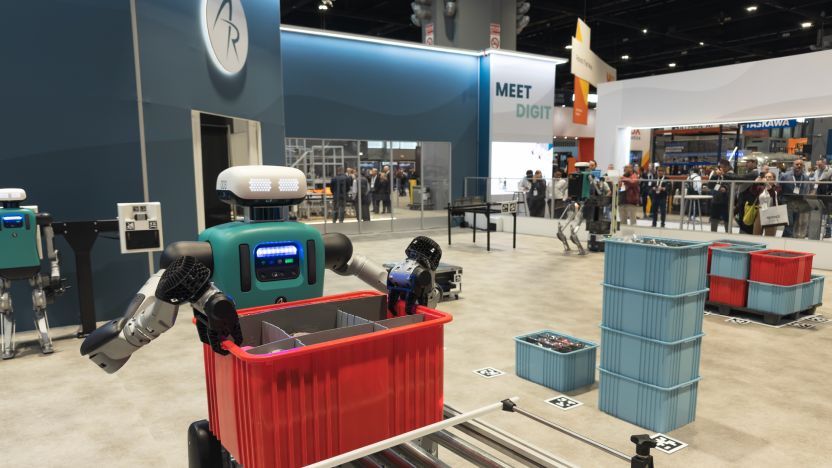
For reference, Digit is 5-foot 9-inches, with an operational range of 5.5-feet, can move a 35lbs payload and has autonomous docking and charging.
The robot’s use cases cross distribution, manufacturing and third-party logistics. Digit is the world’s first commercially deployed humanoid robot and walks, lifts and moves materials and totes through aisles and workflows.
LatAm commerce and fintech company, Mercado Libre, recently announced a commercial agreement with Agility Robotics to integrate Digit into its San Antonio facility in Texas.
The strategic focus is on automating tasks that are challenging to recruit for, especially where the tasks are highly repetitive and require physical strength and stamina.
Amazon has been employing robots since 2012 when it shifted to automated warehousing via the acquisition of Kiva Systems for US$775m. Amazon has invested to create an in-house robotics ecosystem.
Morgan Stanley reinforces media reports in late October that Amazon’s progress across robotics over the last year places the tech giant on track for US$2bn to US$4bn in annual recurring fulfillment/warehouse efficiencies in 2027.
The plans include around 40 Next-Gen Robotics warehouses by 2027 translating into the potential savings based on the broker’s estimates on 20-40% or US0.60 to US$1.20 improvements to the existing circa $3 fulfillment cost assumption per unit.
In contrast, Walmart has sold its warehouse automation unit into Symbotic and, in return, has a multi-year deal and equity stake in the business, as Symbotic’s software and robot fleets are rolled out across most of Walmart’s large regional distribution centres.
Importantly, the only humanoid robot being trialed at scale is Digit at Amazon and soon with Mercado Libre. Existing robotic functionality across Amazon and Walmart is delivered through autonomous mobile robots (AMRs), which are “self-driving warehouse robots” but not humanoids.
Equally, current humanoid prototypes cost between -US$150,000 to -US$500k per unit and run for only two to four hours on charge. The cost of humanoids needs to come down to US$25k–US$50k and the charge time needs to extend to between 8–12 hours to meet real-world work shifts.
In terms of charging, two pathways are evolving: the first is swappable batteries, like some Chinese EV brands, and the second is fast charging during breaks. Both align with current electric vehicle battery models for charging.
Dexterity and mobility remain the most technically challenging aspects.
Tesla’s Optimus is an often-cited example of North American companies’ disposition to develop full vertical integration, from actuators (motors and joints), to control systems (software directing movement), and the AI stacks that allow the robot to see, understand and decide.
Optimus leverages Tesla’s existing EV/FSD infrastructure, including its Dojo compute platform, which processes visual inputs to train AI models. Tesla’s approach allows it to optimise visual perception and maintain end-to-end control of its intellectual property.
Robot foundation models differ from large language models such as Gemini or ChatGPT. Robot models train on robot-specific data —including real-world demonstrations, simulation, and video— to generate smooth, responsive physical actions.
Tesla has tested teleoperation, simulation and video-based learning, with the aim of enabling Optimus to learn from both recorded human behaviour and real-world interactions.
European OEMs are focusing on safety, compliance and human-first design.
Europe’s major advantage is in its component supply chains and regulatory clarity.
The geo-political race for humanoid production and adoption
Canaccord Genuity proposes the next pillar in the US/China AI race is robotics.
As reported by Politico: “it’s the latest example of how the Trump administration is embracing industrial policy in a bid to compete against Beijing in critical sectors such as AI…”
The International Federation of Robotics estimates by 2023 China had 1.8 million industrial robots inside its factories, four times as many as the U.S. China, Japan, Australia, Germany and Singapore all have national robotics plans.
As noted by McKinsey, China’s Ministry of Industry and Information Technology issued a 2024 roadmap for a humanoid ecosystem by 2025, providing the framework for incentives around domestic component production, national benchmarks for humanoid dimensions and safety, as well as funding pilots in logistics hubs and factories.
China had more than 35 new humanoid models launched in 2024, and the strategy mirrors the pathways and success in electric vehicles and industrial robots.
The first AlphaWise survey of C-suites across various industries in China by Morgan Stanley found 62% of respondents are likely to adopt humanoids in the next three years, with 23% satisfied with current products. Dexterity, functionality and price are noted as the key areas for improvement.
Unitree is the most engaged brand, followed by DeepRobotics, Ubtech and Midea. The expected impact on mid- to long-term employment could be “significant”, with predictions of -11% and -28% of jobs possibly replaced by robots in the next five to ten years.
Morgan Stanley acknowledges the survey supports its positive view on humanoid robots, but the sector remains at early stages of development and a ramp-up in volume will take time. The thematic is anticipated to remain topical in 2026.
While China is well advanced, the US and Europe are also progressing the suite of technologies and pathways to androids and humanoids.
As outlined by RBC, multiple companies are working on humanoids apart from Agility and Tesla. Boston Dynamics, owned by Hyundai, is considered a leader with its Atlas robot, one of the most advanced bipedal humanoids.
Unitree, which is China-based, is benefiting from China’s manufacturing infrastructure and ability to scale hardware rapidly. The company’s G1 humanoid is priced at US$13,500 and Unitree is preparing to IPO in late 2025 or early 2026.
Ubtech’s Walker 52 humanoid is promoted as the first with autonomous battery swapping, enabling continuous factory use and is applied in automotive manufacturing, intelligent logistics and data centres.
Mercedes Benz is trialing Apptronik’s Apollo humanoid with a four-hour battery life and advanced safety features, aiming for broader deployment across construction, oil & gas, retail, home delivery and eldercare.
Apptronik has also partnered with Google’s DeepMind to accelerate the development of autonomous humanoids.
What trends in venture capital tell us about burgeoning investment bubbles
With so much conjecture around an AI bubble, it is worth highlighting Aneli Capital, which manages an early-stage venture capital fund, notes the below around both AI and humanoid robots.
Venture capital reports from KPMG and PitchBook show AI remains the dominant theme in 2025, accounting for over half of all investment, while CB Insights data indicates investor attention is shifting rapidly toward industrial humanoid robotics.
The category recorded 17 deals last quarter, the most of any segment, ahead of coding AI agents and copilots (14 deals) and end-to-end software development AI agents (12).
This surge has triggered warnings of a speculative bubble, including from China’s top economic planning authorities, which cautioned the sector to “balance speed against the risks of bubbles.”
Investors say humanoid robotics is attracting capital because AI now gives humanoids commercial potential that previously did not exist. However, Daiva Rakauskaite of Aneli Capital sees strong parallels with the early-2000s dotcom bubble and expects an AI bubble to burst within 2-3 years.
She warns many AI startups with no revenue will fail and similar risks apply to humanoid robotics. Rakauskaite emphasises industrial and logistics robots already generate measurable revenue, whereas humanoids have yet to prove commercial viability.
Although companies showcase impressive humanoid prototypes capable of running or boxing, real-world applications remain limited.
Industrial humanoid robotics still faces barriers in real-time inference, dexterity, reliability and cost, confining early use cases to controlled environments such as warehouses and factories, CB Insights notes.
Rakauskaite urges venture investors to adopt a revenue-first philosophy, focusing on startups with realistic monetisation paths through licensing, partnerships and early revenue streams.
Despite early signs of a bubble in humanoid robotics, Rakauskaite remains optimistic about the broader robotics sector, where cheaper hardware and rapid AI advances are accelerating deployment.
Conclusion, thanks to ChatGPT
“Humanoid robots have stepped out of science fiction and into boardrooms, policy papers and test labs, sitting squarely at the intersection of extraordinary engineering ambition and very real practical limits.
Capital is flooding in, China is accelerating, the US is consolidating and Europe is regulating, all around a technology that is still in its infancy.
Yet the gap between dazzling demonstrations and dependable deployment remains wide: today’s robots can walk, lift and learn, but tomorrow’s will need to do so safely, cheaply and reliably alongside humans.
Whether humanoids become the defining labour technology of the 21st century or simply another overheated chapter in the AI boom will hinge less on imagination than on execution, on breakthroughs in safety, cost, battery life and dexterity, and on the discipline of backing business models that generate real revenue rather than just hype.
If the sector can cross that threshold, history may look back on this moment as the beginning of the age when machines didn’t just compute, but moved, worked and lived among us; if it cannot, this will be remembered as yet another boom that dreamed too boldly.”
This is the final update in FNArena’s GenAI series for 2025. We hope you have enjoyed the content as much as we have enjoyed writing and compiling it for our readers.
While every idea will not necessarily translate into successful stock investments, the content is available to keep readers up to date, aware and abreast of the 21st century’s Fourth industrial revolution.
For more reading on GenAI see https://fnarena.com/index.php/tag/gen-ai/
Find out why FNArena subscribers like the service so much: “Your Feedback (Thank You)” – Warning this story contains unashamedly positive feedback on the service provided.
FNArena is proud about its track record and past achievements: Ten Years On