
SMSFundamentals | Apr 28 2026

Australian wealth hits record, driven by record property holdings. Maybe the lack of equity exposure is the future problem?
- Australian household wealth hit a record in 2025, at $18.85trn
- 66% of all Australian wealth held in property
- Just 9% held directly in equities, compared to over 20% in the US
By Nicki Bourlioufas
Interest rate risk rises with rates
Australian household wealth recently hit a record in 2025, with property gains outpacing those of shares.
But while we are richer than ever, Australians are heavily exposed to rising interest rates, which could erode property values.
Diversifying into shares could help to protect household wealth, even with a potential recession coming.
Household wealth hit a record $18.85trn in the December 2025 quarter, according to recent data from the Australian Bureau of Statistics (ABS).
The nation’s wealth was boosted by property, with households holding a whopping $12.53trn in real estate assets, up 3.0% from the September 2025 quarter, and accounting for 66% of household wealth.
The total value of Australians’ property investment surpassed $12trn for the first time.
In contrast, households held just $1.70trn directly in shares, with a record $1.98trn in cash deposits and $4.55trn in superannuation.
Australians’ level of share ownership remains modest compared to property investment, accounting for just 9% of household wealth, down from around 13% in December 2005.
That contrasts too with the situation in the US where around 23% of total household assets were invested in directly in corporate equities in the fourth quarter of 2025, data from the US Federal Reserve shows, around 2.5 times the proportion in Australia.
Too trusty in property?
With local interest rates up 50-basis points since October 2025, and likely to rise again, possibly as soon as May, Australian households may want to consider boosting their equity exposures and lowering property holdings.
Higher interest rates could dent property demand and prices, particularly if economic growth slows resulting from the war in Iran and a rise unemployment.
Combined with another rate rise in May, the economic outlook could encompass stagflation, recently flagged by the RBA deputy governor Andrew Hauser as a possibility; that is, higher inflation combined with lower economic growth.
According to research from the Reserve Bank of Australia (RBA), a two-percentage point hike in rates, if permanent, is likely to result in a -30% fall in house prices.
While a temporary rate increase would have a lesser impact, clearly higher interest rate rises could hurt property values, especially in locations where mortgage debt is higher, such as Sydney or Melbourne.
CGT discount could see property investment reduce
The current discount in the tax system of a 50% discount (currently at 50% for assets held over 12 months) incentivises investors to leverage up and take on higher debt to buy property.
According to recent media report, the Federal government is currently examining options to cut back on the capital gains discount for property ownership.
By reducing the discount, the tax system would likely mean property investors are less likely to over-leverage, which could push property demand down and prices too.
However, the ultimate impact could be modest. Recent modelling by the Grattan Institute suggests halving the CGT discount to 25% would likely cause property prices to fall by around -1%.
Stocking up on equities
So, could now be the time to stock up on equities, even with a recession potentially on the horizon?
Share prices could fall in the short term if a recession hits Australia or the US, especially if economic growth hits corporate earnings.
That could expose investors now to some risk of capital loss as share prices adjust to lower earnings.
However, average-cost investing during a recession could reduce the likelihood of incurring a capital loss by spreading investments over a period of time which avoids timing the market.
Moreover, lower prices could represent an opportune time to buy equities as the share market is likely to recover before the economy.
Importantly, the stock market typically bottoms out and begins its recovery before a recession officially ends, and bear markets, history shows, create strong buying opportunities.
On average, the US stock market peaks five months before the start of a recession and recovers before the end of the recession, according to research from Russell Investments.
Separate analysis from Fidelity of the US stock market has found that on average, the total return for the S&P500 index in the 12 months after the market found its bottom during any recession is 38%.
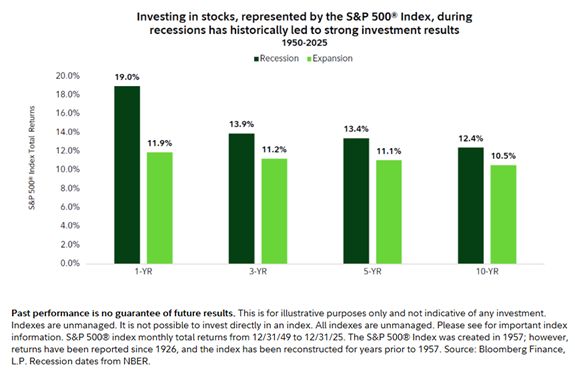
Investing in stocks during a recession has led to better investment returns, as the chart below shows.
Another key point is market recoveries can be swift and the best days often happen soon after the worst.
Analysis of the US stock market by JP Morgan shows the market’s best days often follow the worst days, with 7 of the 10 best days over the past 20 years occurring within two weeks of the 10 worst days.
Missing just the 10 best days significantly slashes returns, highlighting the need to be invested in stocks, and staying invested.
Buying at the bottom of the stock market or during a recession could help to create wealth over the longer term.
In addition to potentially creating greater levels of wealth, equities are far more affordable than property; investors don’t need a big deposit to enter the share market, unlike property which remains unaffordable to many Australians.
Equities have more typically experienced longer, lasting expansion, which have more than made up for the relatively short bouts of volatility that investors have experienced during economic recessions.
Technical limitations
If you are reading this story through a third party distribution channel and you cannot see the chart included, we apologise, but technical limitations are to blame.
Find out why FNArena subscribers like the service so much: “Your Feedback (Thank You)” – Warning this story contains unashamedly positive feedback on the service provided.
FNArena is proud about its track record and past achievements: Ten Years On