
Technicals | May 27 2026

Earlier today, Tony Sycamore, Market Analyst, IG updated his views and thoughts on financial markets, including the technical analysis,
By Tony Sycamore
All material has been re-published with permission and does not by association represent FNArena’s views (we have none, we simply report).
First Up, Nasdaq100
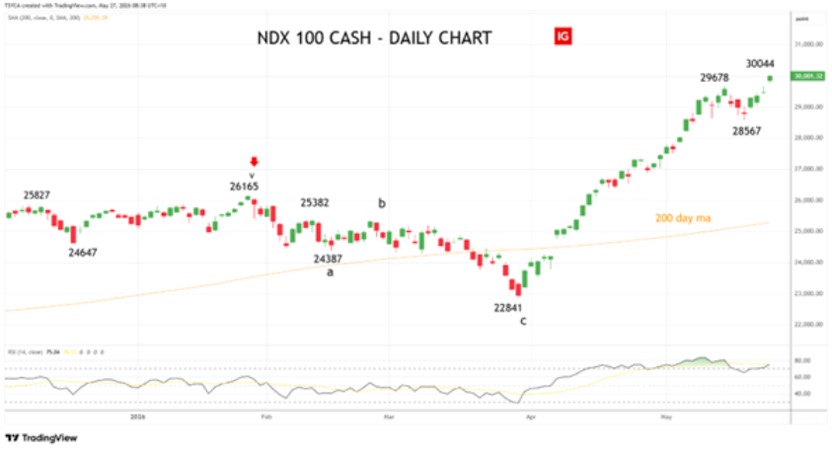
The Nasdaq100 began a correction after hitting its late-October record high of 26,182, before bottoming at the late March low of 22,841.
From those lows, the index launched a powerful rally that took the index through the 30,000 psychological milestone overnight— a level we first flagged on 20 April, albeit it seven months earlier than we were expected
From here, we note that signs of bearish RSI divergence have emerged on all key three US indices.
While this indicates the uptrend is losing momentum, it doesn’t mean that a turn lower is imminent.
More than anything, it suggests chasing the rally at current levels has become increasingly dangerous.
ASX200
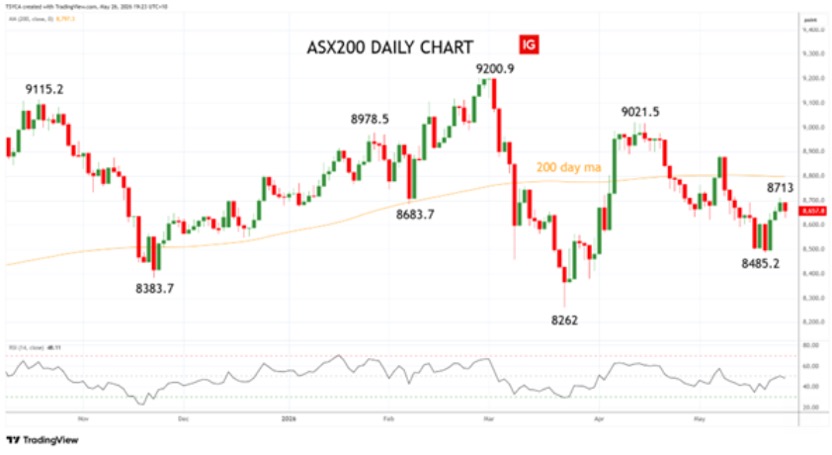
From the mid-April high of 9021.5, the ASX200 has since lost 536 points down -5.9% into last week’s 8485.2 low.
The recovery from that low has the potential to extend back to resistance coming from the 200-day moving average at 8798.
How the ASX200 reacts to that resistance will depend on whether the most recently announced US-Iran peace deal is “signed off” on or fades away into obscurity like the previous five have.
Crude Oil
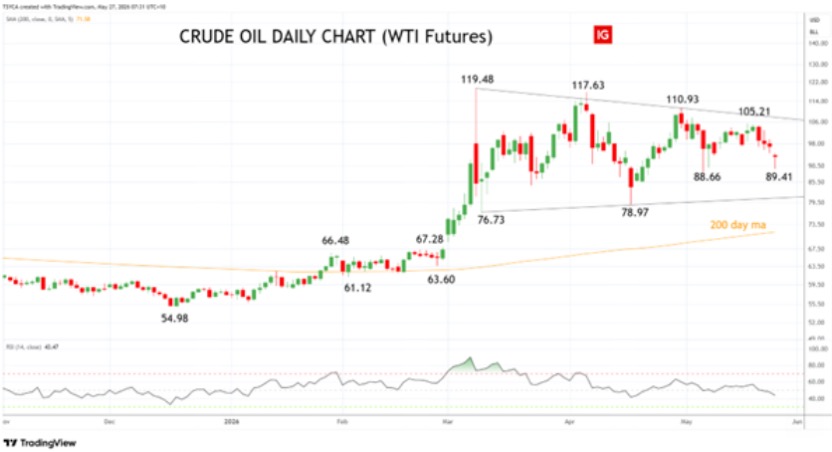
WTI Crude Oil finished at US$93.57 about US$3.27 or 3.60% higher from this time yesterday morning. (Note: There was no official settlement on Monday due to the US Memorial Day holiday.)
The rebound comes as fresh doubts swirl around the trajectory of the latest US-Iran peace efforts.
Yesterday’s flare-up — which saw US fighter jets strike IRGC speedboats and missile sites near Bandar Abbas and other southern coastal areas — have been linked to unconfirmed reports that the US Navy briefly restarted elements of “Project Freedom” to assist vessel crossings through the Strait of Hormuz.
Secretary of State Marco Rubio further tempered near-term optimism, stating that negotiations to extend the ceasefire and reopen the strait will “take several more days” due to disagreements over the wording of the draft agreement.
There are also reports that Iran is unwilling to sign any deal until it can access around US$12 billion in frozen funds held in Qatar.
Finally, on the demand side, attention has turned to China’s dramatic collapse in crude oil imports.
Imports have fallen more than -5 million barrels per day this month — a steeper decline than even during the Zero-COVID lockdowns. The sharp drop reflects Beijing’s strategic decision last year to aggressively stockpile reserves when prices were lower, allowing refiners to now draw down inventories rather than chase spot cargoes.
As we head into the fourth month of the conflict, all of this leaves the oil market appearing relatively calm on the surface — a composure that belies the simmering tensions still lingering in the Strait of Hormuz.
Gold
Gold finished lower overnight at US$4506 down -1.37%, as yesterday’s flare-up in Iran (outlined in the crude oil section above) prompted investors to dial back expectations of a near-term US-Iran peace deal, providing a boost to the US dollar.
Technically, as long as gold remains above support near US$4382 (sustained basis), where the 200 day currently sits, we remain constructive on the outlook.
Aware that a sustained break below the 200-day ma would warn of a retest of the March US$4098 low.
Technical limitations
If you are reading this story through a third party distribution channel and you cannot see charts included, we apologise, but technical limitations are to blame.
Find out why FNArena subscribers like the service so much: “Your Feedback (Thank You)” – Warning this story contains unashamedly positive feedback on the service provided.
FNArena is proud about its track record and past achievements: Ten Years On