Australia | Feb 01 2010

By Rudi Filapek-Vandyck
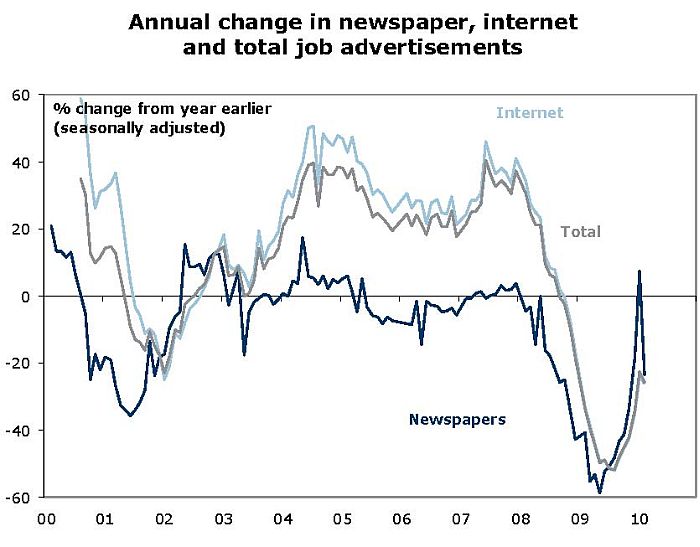
The monthly survey by ANZ into job ads in Australia has generated a negative surprise in its first update into the new calendar year. ANZ bank economists report the January survey revealed job ads on the internet and in newspapers decreased by 8.1% in January, after growing 4.6% in December and 5.2% in November.
Newspaper job ads fell by 16.6%, while internet job ads fell by 7.5% in January. Despite this setback, total job ads continued to grow in trend terms, but not by much: up 1% month-on-month.
The ANZ Job Advertisements Series showed the total number of jobs advertised in major metropolitan newspapers and on the internet fell by 8.1% in January to a seasonally adjusted average of 134,106 per week.
ANZ economists point out that even after this fall, January’s job advertisements were up 7.1% from the cyclical low recorded in July 2009. Adding further to the subdued reading for January was the fact that total job advertisements data for December were adjusted down in seasonally adjusted terms, to plus 4.6% monthly growth, down from a previously reported 6% growth.
In trend terms, growth in job ads decelerated to 1% in December – the slowest pace of growth since August 2009 – but still positive.
ANZ reports the number of job advertisements in major metropolitan newspapers fell by 16.6% in January after growing by 11.6% in December, to a seasonally adjusted average of 8,796 per week. Newspaper job advertisements were 23.5% lower than in January 2009.
In trend terms, the number of newspaper job advertisements grew by 1.4% in January, which marks their weakest monthly growth since July 2009. In annual trend growth rate terms however, newspaper job ad numbers continued to improve, and are now just 3.4% lower than they were in January 2009.
Newspaper job advertisements declined in all states and territories in January, with the largest monthly falls recorded in Victoria (down 26.9%) and Tasmania (down 25.6%) and the smallest monthly falls recorded in WA (down 4.6%) and the Northern Territory (down 11.9%).
The number of internet job advertisements fell by 7.5% to average 125,310 per week. This was 26% lower than in January 2009, but 7% above the July 2009 low point. In trend terms, internet job advertisements grew by 0.9% in January.
In response to the January survey results, ANZ Acting Chief Economist Warren Hogan, comments the monthly decline in Job Advertisements highlights “the fragility inherent in the current recovery phase”. Nevertheless, ANZ expects “more solid growth rates as we move further into 2010”.
Pointing at recent employment data in Australia, Hogan points out a full 30% of all jobs are now part-time and despite the big surge in employed people, aggregate hours worked is just 0.2% higher than a year ago.
This, he says, indicates a significant degree of spare capacity (in other words: under-employment) probably still exists among current employees in terms of their potential to increase work hours as well as employers’ ability to increase headcount.
Hogan highlights forward indicators appear still positive for more employment growth through the first half of 2010, although probably at a slower pace than seen over the past four months.
He predicts the January Labour Force report, due Thursday 11 February, is likely to show another rise in total employment. With the labour force now growing by an average of up to 29,000 per month (average for the last four months), Hogan says Australia will need to see net jobs growth of at least 30,000 in January in order to see a further immediate improvement in the number of unemployed or to move the unemployment rate from its current 5.5%.
ANZ expects jobs growth and labour force growth to run neck and neck until at least mid-2010. This could mean further small spikes in the national unemployment rate. On current trends, reports Hogan, the unemployment rate will probably return temporarily to a high of 5.8% at various times through 2010.
He ads: this is considerably better than the 7% to 8% peak unemployment rates that were widely feared a year ago.