
Australia | May 26 2010

Economy Watch: By Greg Peel
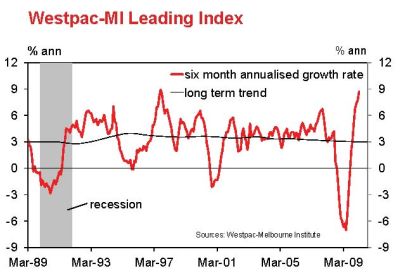
Westpac and the Melbourne Institute each month publish a leading economic index from two months prior, which provides a guide to GDP expectations three to nine months hence. Factors assessed include commodity prices, stock prices, money supply, corporate profits, productivity and dwelling approvals, along with US industrial production, among others.
In March, the index made a huge jump to 8.7%. What this effectively implies is Australia's GDP growth will reach 8.7% before year-end. The jump represents a big gap to the long term trend of 3%.
Westpac chief economist Bill Evans agrees with the index's prediction that the second half of 2010 will show accelerating growth in the Australian economy from the first, with the annualised pace picking up from 3% to 4% on Westpac's forecasts, albeit this leading index reading suggests even faster annualised growth. In the six months to March, the index has increased from 3.3% to 8.7%.
However, Evans also point out the obvious, and that is the nature of taking leading indicators from two months ago mean they're two months old, and clearly the global picture has changed dramatically over April and May. Evans expects a “considerable correction” from this astonishing measure over the next few months.
For one thing, the ASX 200 is off some 15% from its highs. Evans makes no specific mention of commodity price influences other than the past six months have added three full percentage points to the index. Contract coal prices for the quarter were reset in March, and BHP announced its success in negotiating near double iron ore quarterly contract prices on March 30. I'm assuming the 8.7% captures these moves.
In contrast to Westpac's leading index, the official construction work done figures for the March quarter were a disappointment. The 1.9% increase was weaker than economists had expected. Along with weaker retail sales numbers, ANZ's economists suggest this number will lower expectations for first quarter GDP (due June 2).
The breakdown showed engineering work done fell 0.4%, residential work done rose a disappointing 0.9%, and non-residential work done surged 8.6%. Residential was disappointing because economists already expected the big jump in non-residential, reflecting government stimulus packages such as the school works program. Public building work is up 100% over the last three quarters, and Westpac suggests this has “crowded out” the private sector.
While government stimulus is slated to continue for another two years, actual growth in that work will now still. These numbers suggest there is not enough growth apparent in private non-residential construction to pick up the slack straight away, notes ANZ, while private residential should pick up before slowing again into next year.
Private engineering work declined by 3.4% in the quarter, but both ANZ and Westpac suggest the future looks particularly bright. The mining and energy sectors are where most of the growth will come from, despite RSPT fears. Of particular note is the huge Gorgon LNG project which should hit the numbers in the June quarter.
The economists are nevertheless somewhat perplexed as to why Gorgon, which is underway, showed little impact in the March quarter as expected.
Looking at the broader picture, Westpac is forecasting FY11 GDP growth of 3.6% compared to the RBA's 3.5% forecast and Treasury's 3.25% as noted in the budget papers. For FY12, which is out of the range of Westpac's leading index, Westpac is forecasting 3.4% compared to 3.75% from the RBA and 4% from the Treasury.
Westpac expects the RBA to keep interest rates on hold next week.