
Australia | Apr 03 2013

-Mining investment is slowing
-Focus now on operations
-Where will the bigger impact be?
By Eva Brocklehurst
Australia's big question recently is: what will fill the gap in prosperity when the resources boom slows down? The national euphoria which greeted the ramp up of coal and iron ore exports some years ago as China appeared ever hungry for these resources has now subsided to a point where, in some quarters, the doom and gloom merchants are being ushered in. What will fill the gap? What will provide the export dollars?
For analysts at Commonwealth Bank it may be that we are looking in the wrong place for this "gap". Currently, what is happening is more of a reduction in mining construction than exports of mine output. The theory has always been that a bust surely follows a boom.
Expansion of mining has meant capital expenditure in that area has reached a record high share of GDP (8%). Usually, during the "bust" there is a retraction of capital and, given the size of this boom, this bust could also be sizeable. The analysts cite recent RBA research which concluded that around half mining capex was met through imports. That is, large, complex parts and machinery being sourced offshore. This has led the analysts to surmise that there should be an automatic 50% offset in GDP growth from lower imports. If exports continue to increase then this should fulfill the need for more of a balance in exports/imports.
The analysts believe the sort of export growth rates required to achieve this look easy, given the huge growth there has been in mining capital stock. That's another part to the story. A rise in mining capital stock over recent years has boosted the consumption of fixed capital. The mining depreciation share of GDP lifted to 2% from around 0.8% between 2005 and 2012. This means more stock is being depreciated and more capital is required to maintain it.
The analysts describe the "pothole" that may emerge in a downturn in mining investment as labour related. The stock of projects being worked is moving to completion at a faster rate than new projects are starting up. In previous research, the analysts had suggested that the heavy weighting of large LNG projects in the mining pipeline could produce a plateau rather than a peak in resource projects. There are some big investment decisions to be made this year such as the Browse LNG project which, if they go ahead, could produce this plateau effect.
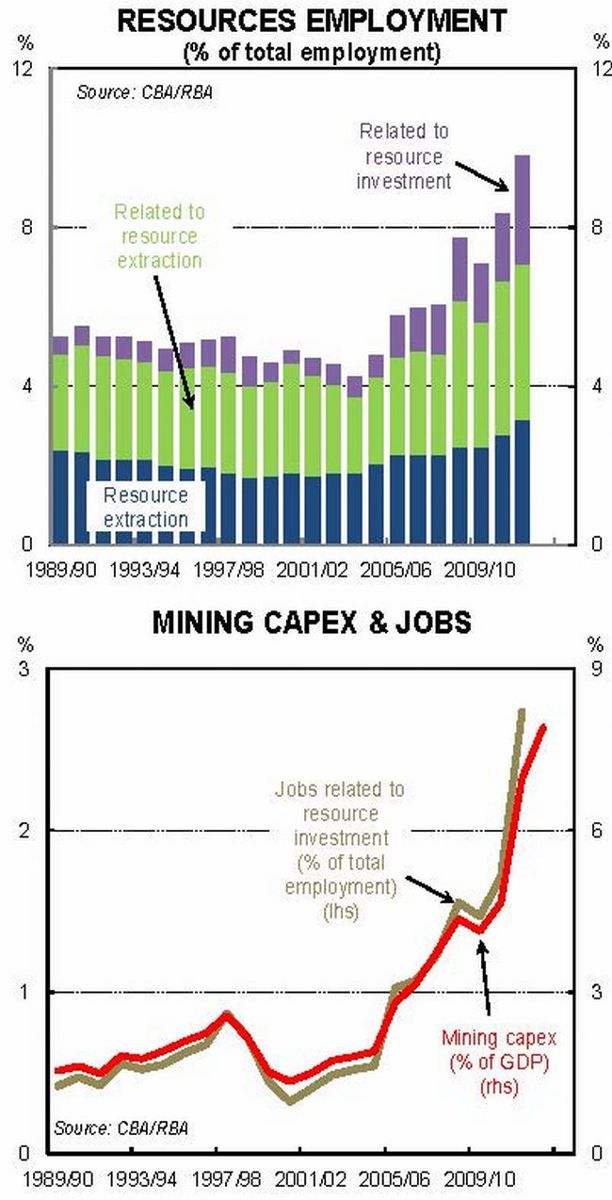
Nevertheless, the investment phase is coming to an end, miners are cutting costs and the focus on operations is becoming sharper. Again, turning to RBA research on the labour market implications of the resources boom, the analysts cite this statistic: nearly 10% of the workforce is associated with resources activity. Within this percentage, resource extraction, the more typical mining employment, accounts for 3.2%, while business activities related to resource extraction add 3.9%. Construction, at 2.7%, brings the total to around 10%.
All components of resources employment are above levels previously regarded as normal. This leads to expectations that a winding down of resource investment will bring job losses. So, the analysts maintain that alternative means of employment are needed to offset any downturn in resources. As they remind us, the resource investment phase is typically more labour intensive than the operational phase. The analysts have crunched numbers, looking at the impact of a 20% fall in mining investment spending from 2013/14 onwards. Over three years that fall could halve the mining capex share of GDP to about 4%. The chart below shows the impact of the halving of GDP share to 4% from 8% and implies a potential job reduction equivalent to around 1% of the workforce.
Technical limitations
If you are reading this story through a third party distribution channel and you cannot see charts included, we apologise, but technical limitations are to blame.
Find out why FNArena subscribers like the service so much: "Your Feedback (Thank You)" – Warning this story contains unashamedly positive feedback on the service provided.