
Australia | May 07 2013

– Investment, employment and borrowing down
– Manufacturing worst hit
– Profit expectations tick up
By Andrew Nelson
Expectations for business spending in the year ahead have continued to deteriorate. The latest word from prominent business information house Dun & Bradstreet is that Australian businesses will keep cutting capital investment, employment investment and new credit through at least the rest of 2013.
This news may well take some by surprise given recently buoyant markets and the re-emergence of at least a little investor confidence of late. Yet despite the slowly creeping optimism, helped along by low interest rates and slowly reviving consumer confidence, for most businesses it remains a tough trading environment, with tight cash flow putting the clamps on business spending.
Dun & Bradstreet’s latest National Business Expectations Survey shows capital investment over Q3 has continued to decline, dropping from positive five to negative three. The index is now sitting at its lowest point in more than three years. What’s even worse is that the investment for the March quarter dropped to negative six. This is the lowest level posted since early 2009, back when everyone was playing duck and cover with the GFC.
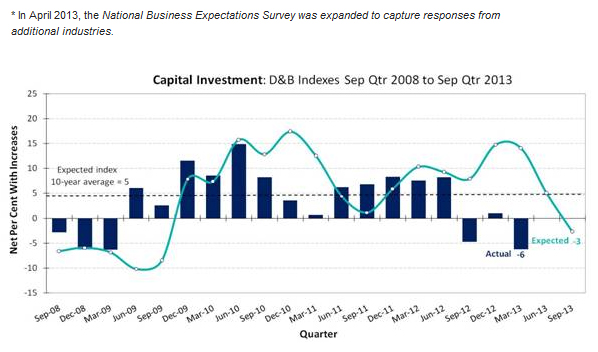
The D&B survey, which kicked off in 1988, looks at businesses from the manufacturing, wholesale, retail, construction, transport, communications and utilities, finance, insurance and real estate, and services sectors.
The hardest hit is the manufacturing sector, which has been consistently cutting back on investment plans. D&B reports not one major business in the sector is currently admitting to plans to increase capital spending. On top of increasingly difficult end markets, manufacturers also have to deal with a very high Australian dollar and increasingly steep operating costs.
This is borne out by the latest data from the Australian Industry Group Australian Performance of Manufacturing Index for March, which recently dropped to its lowest point since May 2009, reports Dun & Bradstreet. This suggests to D&B that the current conservative footing will be maintained by Australian businesses, with plans for new jobs also put on the back burner over the months ahead.
This, of course, leads into a much bigger macro issue: employment. The expectations index has slid into negative territory for the quarter ahead. This is just one more little step in a pullback that began back in early 2012. And now that the official unemployment rate made it up to 5.8% in March, D&B predicts there will be little to assuage job seekers any time soon.
Dun & Bradstreet’s Director of Corporate Affairs, Danielle Woods, finds this latest drop in the capital investment index during the past two quarters concerning and thinks it will likely have an impact on productivity and growth.
“This movement takes expectations back to levels seen during the GFC, and the corresponding movement in employment intentions shows that businesses are continuing to bunker down and limit expenses. This will naturally have a knock-on effect for spending activity in the rest of the economy.
“With the RBA’s figures on business credit showing weak growth, and our survey revealing less than four per cent of businesses intend to access new credit to grow their business, it’s unlikely we’ll see a turnaround on business expenditure in the near-term,” she advised.
On the other hand, Q3 expectations did reveal some signs of optimism. As businesses are now keeping a much closer eye on their expenses, the outlook for profits has actually picked up a little. The index has now recovered to 19 after a big drop to 14 in the previous quarter. Expectations for sales have also improved a tiny bit, up to 14.4 from 13.5.
Almost half of the businesses in the transport, communications and utilities sector are predicting higher profit next quarter, while only 3% expect a decline in earnings. Retailers are also reporting some firmer sales volumes and profit expectations, which fits well with a recent ABS stat showing increasing retail trade over the first two months of 2013.
Selling price expectations have remained flat for the third consecutive quarter, sitting 25 points below its 10-year average at a read of three. That said, the finance, real estate and insurance industries are still planning to increase prices in the coming months.
Stephen Koukoulas, an economics advisor to Dun & Bradstreet, said the fall in expected selling prices that has been seen in earlier D&B surveys has shown up in the recent official inflation data, which also came in well below expectations.
“This news from the business sector adds further weight to the already overwhelming case for an interest rate cut from the Reserve Bank when it meets today. The recent official data on credit growth showed a slowing in activity, and this weakness has continued into the June quarter with the D&B survey also showing a further decline in credit demand,” Mr Koukoulas concluded.
Technical limitations
If you are reading this story through a third party distribution channel and you cannot see charts included, we apologise, but technical limitations are to blame.
Find out why FNArena subscribers like the service so much: "Your Feedback (Thank You)" – Warning this story contains unashamedly positive feedback on the service provided.