
Australia | Aug 01 2013

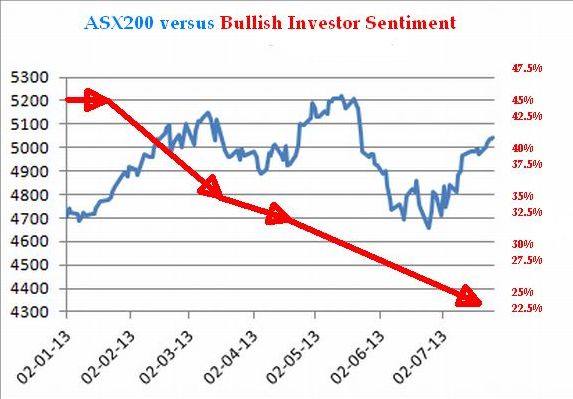
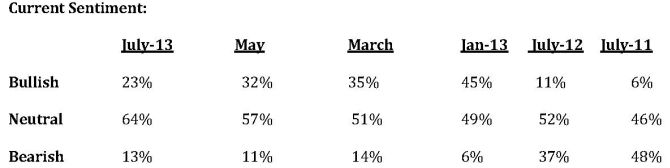
Investors in Australia have grown increasingly cautious towards short-term prospects for local equities with results from the latest Australian Investor Sentiment Survey revealing a steadily declining trend since January is pushing down the percentage of market bulls in all four Surveys held so far this year.
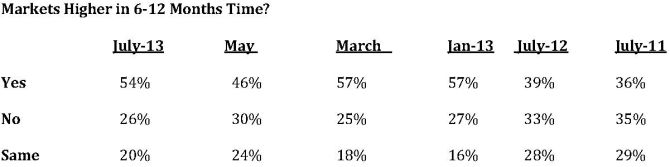
Yet after a dip to 46% in May, a majority of investors (54%) now believes the outlook for the share market holds further gains on a medium-term, 6-12 months horizon.
The July results of the Australian Investor Sentiment Survey by the Australian Investors’ Association (AIA) and FNArena indicate general sentiment remains at significantly higher levels than that seen in 2011 and in 2012.
Alongside the steady decline in short-term optimism this year, investor attention remains drawn to the tepid recovery for the US economy, prospects for less stimulus from the Federal Reserve and economic softness in China.
Since the previous Survey in May, two major points of focus have been added to the list: is the RBA cutting interest rates further and who’s going to win the upcoming Federal elections?
To many survey respondents, the outcome of the election will be the most important driver for the local share market later in the year.
“Every item good or negative seems to send markets into flutter mode for a few days so I feel skittish,” Said Terry from Melbourne.
David said “Must get the election out of the way before stability returns. Longer horizon also depends on steady as she goes in the US.”
An un-named respondent offered “The Australian economy is moving lower. This will impact the performance of the share-market over the next few months. The performance of the Federal Government & its anti-business sentiment has not helped the situation. The Reserve Bank has been too slow to react to the performance of the economy. Sentiment should improve following the Federal election provided there is a change in Government. This will lead to improvement in the economy & flow on to the share-market.”
Most respondents have adopted a neutral view on the share market in the short term. Optimism on a 6-12 months view has bounced following a dip in May, yet remains below levels registered in January and March.
“Within the next six months the election uncertainty will be removed, a change in Government will usher in a ‘honeymoon’ period, which in conjunction with continued recovery in US will extend into a ‘Santa rally’,” said Keith from Cowra.
Matthew from Sydney offered “The global markets are not overvalued. We have seen the worst in the global economy and even if growth is very subdued, we are not going into another recession.”
“I'm not doing any buying, as not certain there won't be further drops between now and November. Or selling at present, as prices are too low and I feel we are at or very near the bottom. But not certain when prices will start to rise again,” said one anonymous respondent.
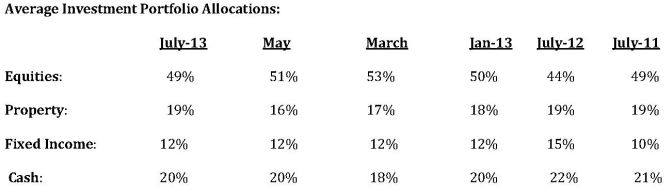
As further evidence of investor caution, the average portfolio allocation to equities, at 49%, has dropped back below 50% for the first time in 2013. An increased number for property (to 19% from 16%) suggests a minor shift into real estate has taken place.
Average cash levels at 20% remain unchanged from May and January, but still higher than the 18% in March.
A number of survey respondents reiterated an intention to allocate a greater proportion of their investment dollar to equities, but this hinges on current causes of uncertainty being resolved. Reduced returns from cash and fixed interest because of low interest rates was the reason most cited.
Bill from Burnside, SA said he has always been “a strong believer in equities over an extended period — the fixed income and cash carries me thru the ups and downs of the market.”
“The Australian share-market is not cheap. I will shift more cash into the market when more value returns to the market. This would happen if there was a significant drop in the market or if there was a significant improvement in the forward earnings estimates,” said an un-named respondent.
In line with the generally more cautious view, investor confidence softened to a read of 57.3%. This remains well above indications seen in 2012 and in 2011 when confidence remained below 50%. Nevertheless, the July Survey outcome marks the lowest confidence level for the year so far.

The Investor Sentiment Survey asked members at AIA and FNArena how they felt about the market and how they were invested. The Survey will be repeated in two months (September 2013). 317 respondents participated through the AIA and 219 through FNArena.
Technical limitations
If you are reading this story through a third party distribution channel and you cannot see charts included, we apologise, but technical limitations are to blame.
Find out why FNArena subscribers like the service so much: "Your Feedback (Thank You)" – Warning this story contains unashamedly positive feedback on the service provided.