
FYI | 11:10 AM

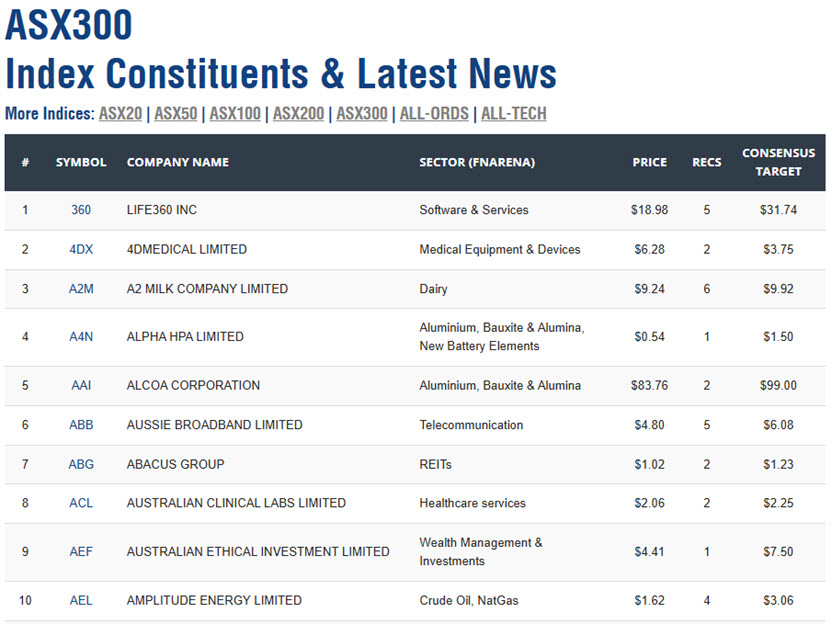
An overview of what goes in and out the ASX300, when and why.
The ASX300 index doesn’t track exactly 300 companies at random. It uses a specific methodology that determines which stocks get in, how much they matter, and when membership changes.
Understanding the calculation mechanics explains why some stocks move the index more than others, why rebalancing dates create trading volume spikes, and how passive funds must mechanically buy and sell.
Market Capitalisation Weighting: The Foundation
The ASX300 index is market-cap weighted. This means bigger companies have bigger impacts on index movements.
Here’s how it works:
BHP moves 2%. The index feels it significantly. A small cap in the bottom ranks moves 10%. The index barely notices.
Market capitalisation equals share price multiplied by shares outstanding. A company trading at $50 with 100 million shares has a market cap of $5 billion. That determines its weight in the index relative to other constituents.
The practical impact:
The largest companies in the ASX 300 collectively drive most index movement. The top 10 to 20 stocks can account for substantial index influence despite representing a small fraction of constituent count.
This creates concentration. When major banks or miners move, the index moves.
When small caps rally, the index barely registers unless it’s widespread.
Free-Float Adjustment: Only Tradeable Shares Count
The ASX 300 uses float-adjusted market capitalisation. Only shares available to public investors count toward index weighting.
What gets excluded:
- Founder and director holdings
- Strategic corporate stakes
- Government positions
- Any strategic shareholding over 5% of issued shares
The Investable Weight Factor (IWF) represents this adjustment. An IWF of 0.75 means only 75% of shares count for index purposes.
Free-float adjustment prevents closely held companies from distorting the index.
The methodology only considers shares that could actually trade if index funds need to buy or sell.
The Divisor: Making Price Changes Pure
Index values don’t directly equal total market cap. They use a divisor to isolate price movements from corporate actions.
Index Level = Sum of Float-Adjusted Market Caps / Divisor
When companies issue new shares, market cap increases but prices don’t change (they can in response to the dilution, but not by default).
The divisor gets recalculated to neutralise this, ensuring the index only moves when prices move.
Eligibility Requirements: Getting Into the ASX300
Not every ASX-listed company qualifies. The methodology sets specific hurdles.
Market capitalisation requirements:
Companies need sufficient size to even be considered. The ASX300 targets the top 300 eligible securities by float-adjusted market cap.
Practically, this means market caps above roughly $100 million, though the exact threshold moves with market conditions.
Liquidity requirements are strict:
The ASX300 index requires minimum relative liquidity of 30%. This measures a stock’s trading volume against the broader market.
Relative liquidity equals median daily value traded divided by float-adjusted market cap, compared against the All Ordinaries benchmark.
A stock falling below 15% relative liquidity (half the minimum) faces removal at the next rebalancing.
This prevents illiquid stocks from becoming index constituents despite having adequate market caps.
Why liquidity matters:
Index funds need to trade these stocks without moving prices dramatically.
Including illiquid names creates implementation problems for passive portfolios trying to track the index.
Semi-Annual Rebalancing: When Changes Happen
The ASX300 rebalances twice yearly, not quarterly like the ASX200.
Rebalancing schedule:
Effective after market close on the third Friday of March and September
Reference date for ranking data is the second-to-last Friday of the previous month.
Announcement comes with advance notice, allowing markets to anticipate changes.
What happens during rebalancing:
- All constituents get reassessed against eligibility criteria
- Float-adjusted market caps get recalculated using the prior six-month average
- Companies get ranked by size and liquidity
- Additions and deletions get determined based on buffer zones
- Investable Weight Factors get updated to reflect current free-float
The six-month average market cap smooths volatility. A company doesn’t get added or deleted based on a single day’s price movement.
The methodology looks at sustained size over six months.
Buffer Zones: Preventing Excessive Churn
The ASX 300 employs buffers to minimise unnecessary turnover.
How buffers work:
- A company must rank 274 or higher to enter the index
- A company isn’t removed until it ranks 326 or lower
This creates a buffer zone where stocks ranking 275 to 325 are either maintained if already in the index or excluded if outside it.
Why this matters:
Without buffers, stocks hovering around the 300 mark would constantly enter and exit. Each change forces index funds to trade.
Excessive turnover creates transaction costs and potential tax implications.
Buffers recognise that companies ranked 299th and 301st aren’t meaningfully different. The buffer zone prevents mechanical churning around the threshold.
Stocks comfortably in the top 274 face no removal risk. Stocks clearly above 326 have no additional prospects.
Only the buffer zone (275 to 325) creates uncertainty.
Intra-Quarter Changes: When They Happen (and Don’t)
Unlike the ASX200, the ASX300 handles intra-quarter events differently.
Key rule:
If a company is removed from the ASX 300 between rebalancings, no replacement gets added until the next scheduled rebalancing.
This means the index can temporarily hold fewer than 300 constituents.
When intra-quarter removals happen:
- Mergers and acquisitions
- Company suspensions or delistings
- Bankruptcy or administration
These forced changes can’t wait for scheduled rebalancing. But the replacement waits until March or September.
Calculation Mechanics: The Real-Time Process
The formula in practice:
Multiply current price by index shares for each constituent
Sum all constituent values
Divide by the current divisor
Index shares represent each stock’s weighting. They’re calculated based on float-adjusted market cap. Large-cap stocks get more index shares, so their price movements create larger index impacts.
Practical Implications for Investors
Understanding this methodology explains observable market patterns.
Trading volume spikes around rebalancing dates as index funds adjust holdings.
Stocks being added see buying pressure. Deletions face selling.
Passive funds must hold every constituent at specified weights (there is some discretion regarding little speccies with minimal index weight).
Front-running occurs as traders anticipate changes and position ahead of (potentially) forced index fund trades.
Market-cap weighting creates concentration. The largest stocks dominate despite the 300-stock count.
Why the Methodology Matters
The ASX 300 calculation methodology isn’t academic trivia. It determines:
- Which stocks passive funds must own
- When mechanical buying and selling happens
- Why some price movements affect the index more than others
- How new companies can enter the index
These mechanics create trading opportunities around rebalancing dates, influence portfolio construction decisions, and shape index fund behavior.
For active investors, understanding when and why index funds must trade creates potential alpha opportunities.
For passive investors, knowing the methodology explains why your index fund makes certain trades and holds specific weights.
The Bottom Line
The ASX300 index uses float-adjusted market-cap weighting, semi-annual rebalancing, liquidity filters, and buffer zones to create a rules-based benchmark of Australia’s top 300 tradeable stocks.
Companies don’t arbitrarily get chosen. Size, liquidity, and free-float determine membership.
Mathematical weighting ensures larger companies influence the index proportionally. Regular rebalancing keeps the index relevant as companies grow or shrink.
The methodology balances representing the market accurately against creating an investable, trackable benchmark that index funds can efficiently replicate.
Understanding these mechanics helps investors interpret index movements, anticipate rebalancing impacts, and recognise why passive funds behave as they do.
FNArena keeps you up to date with Financial and economic news for both small and large investors.
Find out why FNArena subscribers like the service so much: “Your Feedback (Thank You)” – Warning this story contains unashamedly positive feedback on the service provided.
FNArena is proud about its track record and past achievements: Ten Years On