
Australia | Apr 22 2026

Australia has joined the global digital finance revolution that will change how value is stored, managed, and transferred in the modern economy.
- Australian investors, firms, and banks could realise up to $24bn annually through digital finance if regulators modernise and support their licensing and infrastructure
- The key driver of the digital finance revolution is the tokenisation of real-world assets
- On Australia’s current trajectory, it can capture only about $1bn in economic gains
By Erick Nyamagwa
The $24 Billion Digital Finance Revolution in Australia: The Dawn of a New Era for Investors
On March 3, 2026, the Digital Finance Cooperative Research Centre (DFCRC) released an independent research report that quantifies the potential of digital finance in Australia’s financial system.
The report demonstrates if we embrace the usability of digital finance in our economy, as leading jurisdictions such as Singapore, the USA, the UK, the EU, and Hong Kong have done, we could realise around $24bn in economic gains (1% of Australia’s GDP).
For Australian investors, this signals an unprecedented opportunity to engage with technologies such as tokenisation that promise to disrupt traditional markets, boost productivity, and unlock new streams of investment returns.
This article explores these revolutionary changes through the lens of the modern investor, detailing the breakthroughs, challenges, and strategies needed to thrive in this new era.
Overview of Digital Finance Revolution
According to the DFRC, digital finance revolution is the application of new technologies and practices to the financial ecosystem, which reshape how money moves locally and internationally.
Unlike simple digitisation, whereby analogue records are converted into digital form, digital finance brings on board self-custodied (privately managed), transferable, and programmable representations of real-world assets.
These asset representations, in the form of tokens, can be traded directly on a blockchain in real time, 24/7, without intermediaries.
The core technologies driving this digital revolution domestically and globally are:
- Asset tokenisation, which allows traditional financial assets such as bonds, real estate, and stocks to be stored and owned digitally as tokens on a secure blockchain.
- Blockchain technology, which provides decentralised, secure, and transparent financial transaction records on a digital ledger.
- Cross-border payment solutions that enable faster, more secure international transactions, fostering efficient global investment.
Together, these technologies are not just incremental upgrades; they are fundamentally reconfiguring how financial markets operate, creating new business models and investment vehicles.
The DFRC does caution these technologies are not without their challenges. More work is needed to understand how Australia can yield the benefits while managing potential risks in the long run.
The Digital Finance Transformation: Key Drivers
According to the DFCRC, the central driver of the digital finance revolution is tokenisation of assets.
The report reveals the international financial landscape is undergoing a quiet revolution powered by tokenisation, which leverages blockchain technology to make investing faster, more transparent, and more accessible.
With tokenisation of assets, digital tokens are created on distributed ledgers, whereby the tokens represent either ownership, claims or rights to real-world assets (RWAs), such as:
- Stocks
- Bonds
- Commodities
- Real estate
For example, instead of an investor purchasing an entire share of a private company or an entire commercial building in Sydney, they can purchase a fraction of that property as tokens.
These tokens are traded 24/7 on blockchain-based systems, and their transactions are executed in a few seconds.
Economic and Productivity Impacts of Digital Finance
The $24bn in economic gains is not just a figure; it is a quantifiable projected boost to Australia’s economy to be realised from new revenue streams and efficient financial experiences.
Coupled with downstream economic benefits, the gains are projected to exceed this figure, driven by efficient cross-border payments that boost international capital flows and enable access to new markets.
Based on the report, digital finance will attract these economic gains by creating the following for the Australian economy:
- Better Markets
- Better payments
- Better Assets
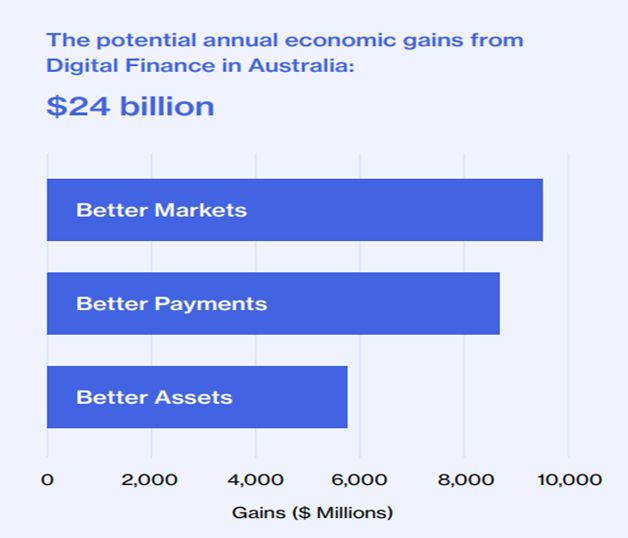
Source: Digital Finance CRC
Better Markets
The Centre found that by modernising financial infrastructure, investors will enjoy greater trading efficiency through instant, simultaneous settlement of payments, improved post-trade processes, and reduced settlement risk.
These improvements will broaden investor access to illiquid assets such as private equity, bonds, and real estate.
They will also make trading these illiquid assets easier by eliminating higher transaction costs and longer holding periods that investors currently experience in the market.
These changes will create better markets by improving capital allocation and asset trading for investors.
Better Payments
Unlike traditional financial systems (card payments), which are slow and complicated, digital finance promises a new era defined by seamless payment procedures and technologies.
With better payments, the movement of money domestically and globally is made effortless.
For example, tokenised money in the form of deposit tokens, stablecoins, and CBDCs (Central Bank Digital Currencies) reduces overreliance on correspondent banks, making trading more flexible and faster, especially across borders.
It also reduces human error by allowing investors to enjoy personalised financial experiences when managing their investment portfolios.
Better Assets
By leveraging blockchain technology and tokenised assets, digital finance transforms how value is stored and transferred between buyers and sellers.
For instance, tokenisation increases transparency, divisibility, and the efficiency of asset issuance, servicing, and compliance, potentially improving liquidity, usability, and flexibility of assets compared with traditional finance.
However, Australia does not currently expect to achieve even half of the $24bn in economic gains by 2030.
It is projected that, on its current trajectory, it can realise up to $1bn per year by 2030, as the adoption of digital finance requires extensive changes that take time.
Investment Opportunities in the New Digital Finance Era
For investors, the digital finance revolution presents multiple investment opportunities.
Investors should expect an upsurge in emerging technologies and infrastructure to support digital finance, such as:
- Blockchain ventures
- Tokenisation platforms
- Cross-border payment solutions
These cutting-edge technologies are likely to disrupt and change how domestic and global financial ecosystems operate.
Australian companies, especially in the asset management sector, are already positioning themselves as global leaders, offering investors opportunities to invest domestically and internationally in these booming fields.
“You don’t want the experience where offshore countries are investing in this, and we are not … if we don’t modernise, capital is very mobile globally, and activity will flow to more efficient jurisdictions, ” said managing director of blockchain and digital assets at Commonwealth Bank, Sophie Gilder in an interview.
Regulatory and Infrastructure Challenges
Based on various survey responses conducted by the DFCRC, the following are the key challenges limiting the adoption of digital finance in Australia:
- Uncertainty and regulatory barriers, where the banking and investment industries are reluctant to implement digital finance due to shaky support/clarity from regulatory bodies. In addition, the lack of mainstream interest in digital finance has led governments/regulators to view it as not urgent.
- Secondly, respondents revealed the absence of key supporting infrastructure and technology is a major constraint limiting adoption in Australia. For instance, respondents revealed the lack of key infrastructure, such as Australia’s Central Bank Digital Currency (CBDC), is a significant barrier. Infrastructure such as CBDCs forms the foundation on which tokenised assets are built.
- Finally, respondents revealed the value of tokenised assets in Australia is insufficient to attract commercial implementation. Even though these technologies, such as tokenisation, are perceived as valuable, their return on investment is not yet strong enough to trigger action.
Where Things Stand
On April 8, 2026, the highly anticipated bill, the Corporations Framework (Digital Assets Framework), received royal assent, ushering in a new regime of digital assets in Australia.
The Bill proposes key reforms that now allow digital finance service operators, such as cryptocurrency exchanges, certain wallet providers, and custodians, to operate under an Australian Financial Services Licence (AFSL), aligning them with traditional financial institutions.
The licence is authorised and regulated by the Australian Securities and Investment Commission (ASIC).
This means Australia has laid the foundations and is at a pivotal moment, despite the global environment moving quickly.
The question now is how quickly Australia can adapt and whether it can capture these economic benefits, or become a consumer of financial infrastructure developed elsewhere.
Conclusion
The digital finance revolution is not a different era. It is an era that will change how value is stored, managed, and transferred in the modern economy.
Technologies such as asset tokenisation are still in their early stages, but their trajectory is clear.
In an increasingly digital world, expect digital finance to be the pillar of the next generation, because sometimes, improved infrastructure is only realised after decades.
As regulators and institutions are coming together to build functional frameworks for digital finance, investors have the choice whether to position themselves to benefit from the competitive advantage of early adoption.
Find out why FNArena subscribers like the service so much: “Your Feedback (Thank You)” – Warning this story contains unashamedly positive feedback on the service provided.
FNArena is proud about its track record and past achievements: Ten Years On