
Commodities | Sep 25 2007

By Greg Peel
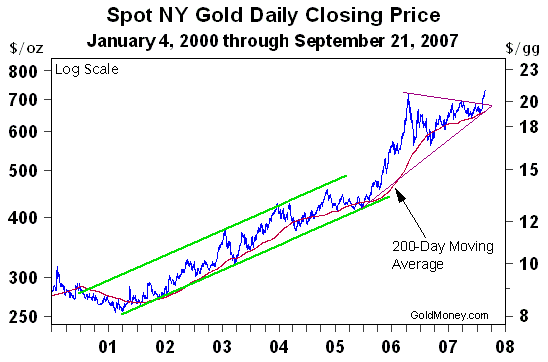
There are a number of reasons why gold has rushed up to trade at US$730/oz recently:
(1) The subprime-inspired global asset sell-off is over for now; (2) gold has regained its safe haven status in times of financial uncertainty; (3) it has responded to increasing geopolitical tensions between the US and Iran, and Israel and Syria; (4) it has equivalently responded to the higher oil price; (5) demand from Asia is rising as we approach ceremonial seasons; (6) EFT buying has returned; (7) global supply continues to drift lower (BHP rumour notwithstanding); (8) the Fed rate cut has sparked inflation fears; (9) central banks have not sold heavily into the rally as they have done in the past; (10) there was a chart break below US$700/oz; (11) as the US dollar falls, the US dollar price of gold rises.
Of all these reasons, (11) is probably sparking the most debate at the moment, as precipitated by (8). When the Fed cut the cash rate by 50 basis points an already weak US dollar fell markedly against major currencies including the euro, pound, yen, and Canadian, Australian and Kiwi dollars. This surprised very few, although there are commentators that insist the US dollar is currently offering a good buying opportunity – despite the general belief the Fed may need to cut rates again.
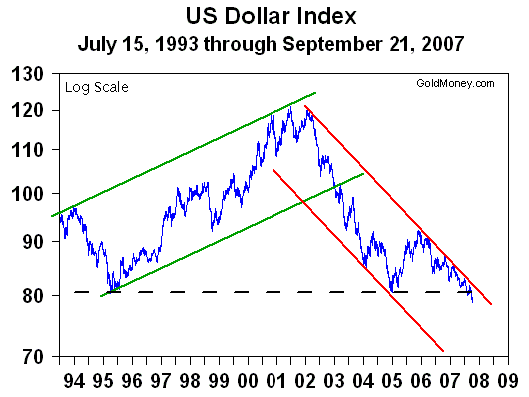
The general reason is that the Fed rate cut was implemented to prevent a US recession. If the action works, then the US economy should be able to retain positive, albeit modest, growth and thus the US dollar should appreciate. More specifically, expectations are growing that both the European Central Bank and the Bank of England will also be forced to cut rates next month, thus evening up the equation.
In the case of the yen, well it’s all about the carry trade. The Bank of Japan would dearly love to increase its rate and stick it to the carry traders but Japan, too, has been caught up in the credit crunch and is still suffering from a lack of economic growth or inflation. So the US dollar has actually regained some ground against the yen due to Japanese borrowings, which in turn have reignited the “commodity currencies” of Canada, Australia and New Zealand whose strong economic growth has led to higher interest rates and thus greater carry trade opportunity.
Apart from the mathematical equation that implies a higher gold price from a lower US dollar, many an economist – professional or amateur – across the globe is screaming the I-word. In order for the Fed to “bail out” the profligate financial sector with lower interest rates it must in effect print dollars. This monetary base expansion is by definition, they argue, inflationary. Then throw in the purely empirical notion that filling up the car or doing the grocery shopping is becoming increasingly more expensive and you have an inflationary environment – big time. For the gold uber-bulls this is like ultimate vindication. And they would suggest gold would already be over US$1000/oz if it weren’t for (9).
Rubbish, say the non-inflationers. What is this crisis we’re in at the moment? Oh yes, a housing crisis. There are few who argue against the assumption that US house prices still have a way to fall. This is deflationary. As is the potential fall-off in consumer demand for many related items such as furniture, TVs or cars. US inflation is currently at a well-contained 2% (core). China continues to export deflation in manufactured goods. The renminbi is pegged to the US dollar. Where are the inflation signs? they ask.
They might well be apparent in the gold price at the moment, but then the non-inflationers are bemused as to why gold is so popular. There is little correlation between the gold price and subsequent inflation in recent history. Similarly there is an argument that US ten-year bond yields are rising, which is another indication of expected inflation. The nay-sayers point out that 4.6% is hardly the stuff of panic.
The nay-sayers suggest (3) is a more justifiable reason for gold’s strength, which is interrelated with (4). Without geopolitical tension, the US economic slowdown we all expect would provide downward pressure on the price of oil.
As for (9), it is apparent the Fed is presently happy to sacrifice the dollar to prevent a recession if that’s what it has to do. The Fed may also believe that a stabilised US economy will promote stability in the currency. But it is also a fact that we are just about to pass the cut-off date for central bank gold selling under the Washington Agreement. While a lot of gold was sold by central banks this past “year”, the total still fell short of the allowable quota. The slate is clean again, and the likes of Switzerland and maybe even Germany can begin to assess the benefits of selling into a strong market. But other central banks perhaps don’t have much left to sell.
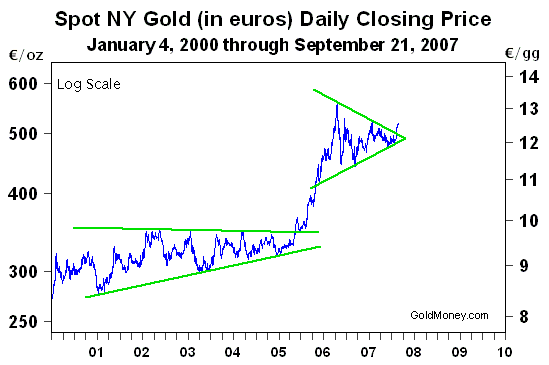
The break-out in the gold price is not just a US dollar phenomenon. Gold has also broken out against the euro, which in turn is at historic highs against the US dollar. This suggests the rise in the gold price is as much about all the other factors. As to whether those factors are justifiable or not is the basis of the argument.
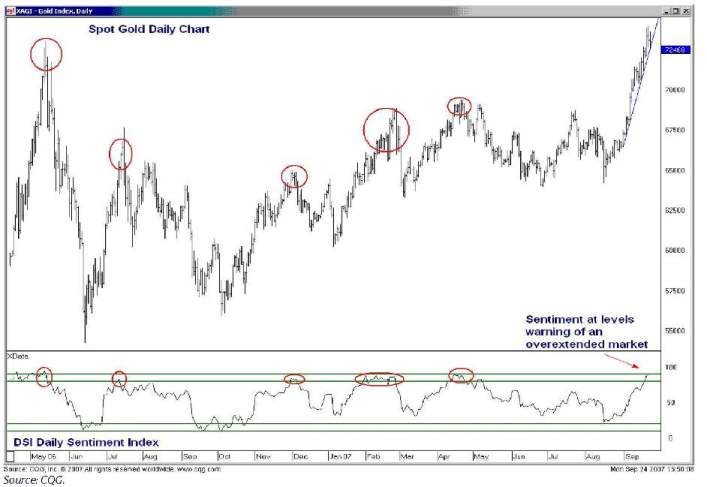
From a technical perspective, chartists agree that the longer term direction appears to be up. In the medium term, the next level of resistance is at US$775-780/oz. In the short term however, the signs are that gold is overbought. The following chart from Barclays Capital makes particular note of the rise in sentiment level and the history of such rises.
All the other charts in this article have been provided by GoldMoney’s James Turk – an uber-bull to whom we will give the last word:
“Why is gold moving up against the euro? For the same reason gold rose against all the currencies of the world in the 1970’s. Today’s monetary problems like those three decades ago span far beyond the US; they are global. We are witnessing a flight from national currency into the safety and security of gold. Expect more of the same. Expect gold and silver to continue climbing higher.”