
Commodities | Jul 31 2008

This story features NEWCREST MINING LIMITED, and other companies.
For more info SHARE ANALYSIS: NCM
By Greg Peel
It’s very, very hard to find a gold stock analyst in Australia who is not currently bullish on the gold price in the bigger picture. That’s why there are more Buy ratings than anything else on Australia’s only two locally-owned majors – Newcrest ((NCM)) and Lihir ((LGL)).
But previous calls for the gold price to not only push through US1000/oz again in 2008, but even on to US$1100/oz (as GFMS has suggested) are beginning to look optimistic as gold struggles to hold above US$900/oz. A look at this one-year chart shows gold raced off to tag the US$1000 level before falling back to trend as might have been expected. However, the price has since fallen below trend, and despite trying to regain momentum twice, both attempts have failed.
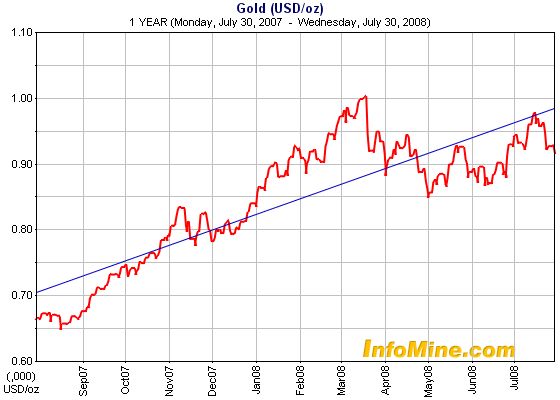
The most recent attempt saw the gold price bang up against the trendline on July 15 – the day the US government announced it would save Fannie & Freddie. But on the announcement of the rescue package, it was game over once more. The US$1000 peak was hit in March, when Bear Stearns went down. Bear Stearns was a mere insect compared to Fannie & Freddie, yet gold has not pushed above this peak again. In the one-year history of the credit crunch, has anything been as perilous as Fannie & Freddie day?
And what’s more, the Fed giving a $30bn loan to JP Morgan to bail out Bear Stearns is one thing, but offering to prop up half of the US$5trn mortgage market is another, and one which should imply incredible strain on the US dollar.
But since the US dollar hit US$1.60 against the euro in Bear Stearns week, it has never been back there again. Indeed, the US dollar index (against a basket of currencies) fell to 72 at that time, and has traded in a range between 72 and 74 ever since. The realities of the credit crunch have only become more apparent since March, but the US dollar has plateaued.
As respected trader Dennis Gartman put it last night, “Since [Bear Stearns], even with the growing problems attendant to Freddie Mac, and Fannie Mae, and with the growing concerns about the US banking system, it is fascinating to us that the dollar has refused to make a newer and worsened low. Indeed, amidst the Fannie/Freddie/Merrill Lynch furore of the past two weeks, the dollar has actually strengthened.. This we find fascinating”.
And Gartman’s subsequent pearl of old trader wisdom is that if something is fundamentally bearish but the market does not respond, then notice must be taken. And the same works to the bullish side, which is why last night Gartman announced he was abandoning his long gold position. For gold’s refusal to push higher on supposed financial mayhem is directly linked to the resilience of the US dollar.
“We shall be frank,” Gartman declared, “after several years of trading gold very, very well, we have traded it very, very poorly in the course of the past two months. There is no reason to mince words, for the facts speak for themselves. We have tried to err upon the side of bullishness, and for two and three years that served us well. It is serving us ill now, however. If the dollar is turning for the better, gold shall be turning for the worse”.
So why is the US dollar turning for the better? Surely there is currently a round-the-clock team at the Treasury printing press pouring water on the machine to keep it from overheating. Between Congressional approval to nationalise US mortgages if necessary, and the Fed vowing to hold all its windows open for as long as it takes, the gears must be white-hot.
One answer probably lies in the fact US$1.60 to the euro has been established as a floor for the greenback (a ceiling if you speak in euro terms) given the G7 has continually hinted that a breach of this level could spark global central bank intervention with the intention of saving the world. But the more obvious answer lies in the word “decoupled”.
From the beginnings of the credit crunch, economists optimistically predicted that the fallout would be US-centric. It was the US that had got itself into this mess, and while that would play heavily on US economic growth (which was already anaemic), Europe was emerging from a period in the doldrums and Japan even looked like returning to positive growth as well. And as for China, all of Asia, and indeed all emerging markets, these had become economic entities unto themselves. The emerging economies were firing along happily as domestic demand grew, and reliance on exports to the US, and thus a strong US economy, was no longer a factor.
The rest of the world had “decoupled”. For Australia, this meant ongoing economic growth alongside the ongoing Chinese miracle.
This was the mantra at the beginning of 2008. Seven months later, it’s a different story altogether. European confidence has collapsed, and its economy appears set to turn. The UK housing market is sitting on a precipice. Japanese exports have collapsed. The Australian economy has apparently fallen into a hole far more rapidly than most thought possible. And economists now expect Chinese economic growth to slow from 12% to more like 9% or maybe even 8%. For China, this is as good as a recession.
There is no longer talk of “decoupling”.
Which means that the US is not on its own. And given exchange rates are only relative, if the world economy is slowing in tandem then exchange rates will not change. The US copped the initial brunt and the Fed cut the cash rate from 5.25% to 2%, which gives us a dollar index at 72. But there it has stopped. If the rest of the world is going to weaken, then the US dollar need fall no further, and may even rally. it has already endured the pain that others may be yet to fully endure.
The gold price is measured in US dollars. Ergo, if there is little downside for the US dollar relative to the rest of the world then there is little upside for gold.
The gold price left behind jewellery demand somewhere back around US$800/oz, so even though this threshold may rise once more gold has only been acting as a currency lately and not a commodity. It is the store of wealth in times of uncertainty and/or high inflation. Uncertainty remains, but for now the dollar and US stock prices seem to have found a level. Inflation remains, but the oil price is no longer threatening to go to US$200/bbl tomorrow.
What is the reason to hold gold?
The story is not over yet, however. The US government is still technically insolvent, and all the rescue packages backed by monopoly money must come home to roost one day, making gold attractive in the long term. But provided we don’t have a nuclear war in the Middle East anytime soon, US1100/oz in 2008 is looking ambitious.
Click to view our Glossary of Financial Terms
CHARTS
For more info SHARE ANALYSIS: LGL - LYNCH GROUP HOLDING LIMITED

For more info SHARE ANALYSIS: NCM - NEWCREST MINING LIMITED