
Feature Stories | May 20 2026

This story features COMMONWEALTH BANK OF AUSTRALIA, and other companies.
For more info SHARE ANALYSIS: CBA
The company is included in ASX20, ASX50, ASX100, ASX200, ASX300 and ALL-ORDS
The March quarter turned sour for the banks and bad debt provisions were increased, ahead of a federal budget that will have significant impact on mortgage demand.
- Banks revenue growth turns negative in the March quarter
- Provisions against bad debts topped up in weak macro environment
- Tax changes in the budget will undermine property investment
- Even after share price weakness, questions remain about (in)appropriate valuations
By Greg Peel

Early this year, bank share prices were on a tear. The average major bank total shareholder return (capital gain plus dividends) of 12.5% in the month of February was significantly better than the ASX200’s 4.1%. Commonwealth Bank ((CBA)) led with 18.5%.
In February, CBA reported first half earnings while ANZ Bank ((ANZ)), National Australia Bank ((NAB)) and Westpac ((WBC)) provided December quarter numbers and updates on the month of January.
Following a positive reporting season, Morgan Stanley suggested the banks’ earnings upgrade cycle, solid balance sheets and low risk profile would continue to support investor interest.
The RBA implemented its first rate hike in February. While bank PE multiples typically de-rate during an RBA hiking cycle, Morgan Stanley believed recent results were likely to keep valuations elevated in the near term.
Morgan Stanley also believed the sector was late in its outperformance cycle, with de-rating risks rising as the year unfolds.
Emerging stumbling blocks were identified as downside risks to the economy, loan growth and credit quality from the combination of monetary and fiscal policy pivots, the potential for another outbreak of competition as the five largest banks try to implement their strategies, and execution risks around transformation and productivity agendas.
The broker thought elevated expectations and multiples skewed the risk toward underperformance versus the ASX200 in 2026 rather than another year of outperformance.
Then at the end of February, Trump bombed Iran.
May Results
This month, ANZ, NAB and Westpac released first half FY26 results (September year-end) while CBA and Macquarie Group ((MQG)) provided a March quarter update.
The fact the RBA chose to hike at its February meeting, pre-war, indicated inflation was already sticky and indeed creeping up again. The RBA has since chosen to Implement two more rate hikes, thus wiping out the three prior cuts that signalled the end of the post-covid inflation surge.
Inflation is now rising again, suggesting more rate hikes to come. But the inflation caused by the spike in fuel, fertilser and other prices and the subsequent flow-through to the general economy is supply-side inflation, not typical demand-side inflation which drives a strong economy and prompts the RBA to cool things down with a rate hike.
Supply-side inflation threatens a weaker economy, which is why another rate hike at the RBA’s June meeting is not considered inevitable, even if inflation readings continue to rise as expected.
Following the March bank reporting season, the outlook for Australian banks has become more challenging, Ord Minnett suggests, prompting a less constructive sector view.
The shift in sentiment reflects a marked change from the February reporting season. At that time, banks delivered strong revenue growth and benign asset quality, leading to consensus revenue upgrades and lower expected credit impairment charges.
The subsequent May reporting season told a different story. Revenue growth stalled, asset quality indicators began to soften and banks moved to rebuild collective provisions. As a result, consensus earnings per share downgrades have effectively unwound the earlier upgrades.
Two clear themes emerged, Ord Minnett notes. First, revenue growth has decelerated across all major banks, even after adjusting for markets income volatility and day-count effects (fewer working days in the quarter).
Second, quarterly outcomes are proving highly volatile, reinforcing the risk of extrapolating short-term trends. Aggregate quarterly revenue growth for the major banks fell from a strong December quarter to flat in the March quarter, with all institutions experiencing a noticeable slowdown.
Macquarie agrees in a sharp turn from the December quarter, banks showed softer trends in March.
Revenue growth was weaker, falling -0-5% quarter on quarter, after rising 1%-4% in the December quarter. While better cost management partly offset this weakness, pre-provision profits fell -1%-9% quarter on quarter. Volatile markets income and FX contributed to softer revenue outcomes, but with lending competition increasing and downside risk to volumes, Macquarie expects revenue trends to remain challenging ahead.
Underlying margins were softer than expected, Macquarie notes, mostly holding flat, while lending competition stepped up.
With downside risk to volumes, and ANZ Bank looking to return to growth, Macquarie expects lending competition to remain intense. Higher rates will provide some tailwinds to margins, but this is now largely built into expectations.
Expenses were generally well managed across the banks, Macquarie notes, with underlying expenses down -9 percentage points to 2%, albeit this was supported by a weaker New Zealand dollar.
ANZ and Westpac both increased productivity goals for FY26 as they sought to target better tier one capital. While there is scope for expenses to continue surprising positively, with ongoing inflation and IT transformation programs, Macquarie thinks this is insufficient to offset near-term risks to revenues.
Banks elected to top up provision coverage (against bad debts), other than ANZ. Credit quality trends were mixed, with continued improvements at ANZ and Westpac, but some deterioration in non-performing business loans at NAB and CBA.
With a challenging macro outlook likely to continue, Macquarie continues to see upside risk to bad debts in the near term.
Credit conditions remain sound, supported by low unemployment and resilient property prices, but early signs of stress are emerging in certain corporate exposures and personal lending.
Hence, banks have prudently, in Ord Minnett’s view, increased collective provisions, particularly as reliance on internal credit risk modelling has grown following Basel 3 changes.
Overall, brokers have made minor earnings forecast changes, yet current sector multiples don’t yet fully reflect a sector in transition, in UBS’ opinion, moving away from a benign credit and interest rate tailwind environment to one of rising provisions, slowing mortgage growth, and policy adjustments.
Individuals
Following the February bank result season, CBA was the outperformer, once again defying near perennial calls of overvaluation. CBA’s quarterly update this month was a slight miss (-2%), with UBS pointing at collective provision overlay charge and soft revenue despite a stable net interest margin (NIM).
In a case of unfortunate timing, CBA reported the day after Jim Chalmers brought down his 2026 budget, which saw its share price drop around -10% in the session — the largest one day fall since the bank’s IPO in 1991.
CBA is still growing above system in deposits and business lending and at system for mortgages.
Macquarie Group showed strong Macquarie Capital and Commodities & Global Markets outperformance from some $1.1bn in asset realisation and commodities trading revenue reinforcing its diversified model, UBS notes.
Westpac’s result was largely in line, however Westpac has the highest capital ratio relative to peers. Cost benefits from the bank’s Unite efficiency program were evident, but NIM compression could offset this.
NAB beat on NIM but posted a slight income miss. Despite a beat on cost, earnings still underwhelmed.
ANZ missed on income but beat on costs and earnings.
The Budget
While there were many elements in the budget, all focus has been on tax changes impacting property investment.
As expected, the federal government will scrap the flat 50% capital gains tax (CGT) discount for investments for more than 12 months, a measure largely sold as addressing intergenerational housing inequality.
Flying well under the radar was a budget acknowledgement that Investors in the share market are undercompensated for the impact of inflation under current CGT settings. The budget highlighted the potential to shift investment away from existing properties and into new properties, but also into stocks.
CGT is paid on capital appreciation of share prices, but not on dividends which, if fully franked, attract no tax. Hence the budget suggests it is less attractive from a tax perspective to invest in high-growth, no or low-dividend payers and more attractive to invest in slower growing high yield stocks, such as banks (some of them).
It is rarely acknowledged that if you’re paying more tax you’re making more money, but never mind.
Yet, while bank investment may look more attractive from a tax perspective, UBS views the budget as slightly negative for overall mortgage growth, due to the loss of tax incentives for investor mortgages (56% of mortgage flow, and 33% of mortgages outstanding for the majors at end of the first half).
Overall, UBS believes the bank stocks most exposed are CBA and Westpac, with lending portfolios more tilted to investor mortgage lending.
Budget reforms will impact the property market, including restricting negative gearing to new builds and replacing the capital gains tax discount with an inflation indexation model. These changes are expected to reduce investor capital allocation to existing housing stock, Citi notes, potentially impacting supply while rising construction costs and rising rates also have an impact.
APRA’s proposed easing of residential property lending requirements could increase bank capacity, but overall Citi sees downside risk to mortgage credit given the tax changes, negative sentiment and lower turnover of existing and grandfathered stock.
Given the total expected return of bank shares has skewed to franked yield, Citi thinks this looks more attractive given the changes to CGT. Nevertheless, the broker expects downside risk to housing credit to receive more prominence in the budget debate.
At the margins, the removal of the CGT discount is incrementally negative for investors in growth assets depending on time horizons, Citi notes. From a total return perspective, the greater proportion of total return derived from income (including franking) at the banks looks more attractive from a tax structuring perspective.
Yet on balance, Morgan Stanley thinks new measures in the budget will be bad for bank share prices. While changes to negative gearing and CGT discounting had been flagged, the minimum 30% tax rate on post-July 2027 capital gains was unexpected.
In Morgan Stanley’s view, the budget will have a negative impact on housing market sentiment and the mortgage market. This will more than offset any increase in the appeal of high-yield stocks.
Favourable tax treatment is one of the reasons why there has been a 30-year housing “super-cycle” in Australia. Changes to property-related tax concessions could have a “profound” effect, Morgan Stanley suggests, on the long-term demand for investment properties.
All else equal, less leverage and less property price appreciation imply more modest mortgage growth, creating a headwind for earnings. More importantly, Morgan Stanley suggests, investors may consider whether banks should trade on lower PE multiples to reflect lower terminal growth rates.
On UBS’ assessment, the budget reduces the after-tax appeal of leveraged established-property investment and should slow investor mortgage growth (20% of system and 40% of mortgage flow).
Construction finance, presale-linked lending and new-build mortgages should benefit, but planning, build costs and developer risk mean this will not quickly replace established-investor turnover.
Grandfathering limits forced selling and credit risk, but the sector faces weaker housing system growth, poorer mortgage mix and more competition for owner-occupier flow.
Investor mortgages for the large banks have grown strongly over the past decade (CBA the most), as banks have pivoted toward higher-margin business to defend retail profitability, especially over the past four years.
Investor loans typically price better for the banks (higher interest rate) than prime owner-occupier loans. If growth rotates from investor lending into owner-occupier/first home buyers, the volume may be partly offset, but the margin mix is likely worse, UBS believes.
The Outlook
Morgan Stanley currently forecasts system mortgage growth to moderate from a recent run-rate of around 7.5% to an average growth rate of around 5.5% in FY27, with investor loan growth slowing from 10% to 7%.
The broker thinks system growth could slow to 3%-4% in FY27 if the RBA retains its tightening bias and house prices fall some -10%. By way of comparison, mortgage growth fell to 3% in 2019, when investor loan growth hovered around zero for most of the year.
Separately, Morgan Stanley believes the implications for credit quality and loan losses will depend on the impact on interest rates, the labour market, consumer spending, business input costs and business investment.
The relative “winners”, UBS suggests, are likely to be banks with stronger business and institutional banking franchises (NAB and ANZ) and less reliance on investor mortgages (CBA and Westpac).
UBS points out there are a number of unknown factors which might have an impact on bank share price performance too, such as investor flows, appetite for higher dividend yield stocks, and asset allocation/rebalancing.
Bank stocks were down around -12% over the month heading into the budget, likely pricing in concerns of negative earnings revisions on these budget changes, UBS suggests, amongst other factors.
Citi remains cautious on the banks given the risks from stagflation, with slowing growth and rising credit risks offsetting the impacts of higher rates. The risk is the tax changes from both a CGT and negative gearing perspective add a cautious overlay to housing activity, which holds some downside risk to earnings for the banks.
The major banks are relatively evenly exposed to this risk, albeit Citi notes housing investors have been a greater proportion of CBA’s recent growth.
Ord Minnett agrees: risks are rising. Changes to negative gearing and CGT, combined with higher interest rates, are expected to materially slow investor housing credit growth.
Earnings momentum has turned, notes Ord Minnett, valuations remain stretched by historical standards, and further downside risk remains if housing credit slows more sharply than currently forecast.
Macquarie remains Underweight the bank sector.
ANZ Bank is now the preferred exposure across major banks as Macquarie sees less risks from credit quality given its institutional exposure.
ANZ trades at a discount to peers which may provide some support if the sector de-rates.
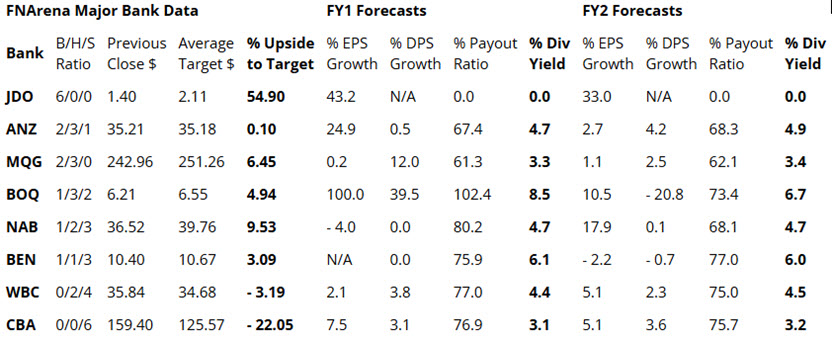
As the table above suggests, Macquarie is not alone in preferring ANZ among the majors. Disruptor Judo Capital ((JDO)) is clearly most favoured (cheap valuation), but does not yet pay dividends.
CBA is in its familiar spot with six from six Sell ratings from brokers monitored daily by FNArena covering the banks (only five for Macquarie Group, as Macquarie does not rate itself).
As a “high yield” stock, CBA does not rate so highly with only a 3.2% forecast dividend yield compared to the other majors, with Macquarie Group not far behind.
Technical limitations
If you are reading this story through a third party distribution channel and you cannot see the table included, we apologise, but technical limitations are to blame.
Find out why FNArena subscribers like the service so much: “Your Feedback (Thank You)” – Warning this story contains unashamedly positive feedback on the service provided.
FNArena is proud about its track record and past achievements: Ten Years On
Click to view our Glossary of Financial Terms
CHARTS
For more info SHARE ANALYSIS: ANZ - ANZ GROUP HOLDINGS LIMITED

For more info SHARE ANALYSIS: CBA - COMMONWEALTH BANK OF AUSTRALIA
For more info SHARE ANALYSIS: JDO - JUDO CAPITAL HOLDINGS LIMITED
For more info SHARE ANALYSIS: MQG - MACQUARIE GROUP LIMITED
For more info SHARE ANALYSIS: NAB - NATIONAL AUSTRALIA BANK LIMITED
For more info SHARE ANALYSIS: WBC - WESTPAC BANKING CORPORATION