
Commodities | Apr 03 2008

This story features BHP GROUP LIMITED, and other companies.
For more info SHARE ANALYSIS: BHP
The company is included in ASX20, ASX50, ASX100, ASX200, ASX300 and ALL-ORDS
By Greg Peel
Readers are directed to “Preparing For The Aluminium Boom” (Sell&Buyology; 07/02/08).
The story so far:
Aluminium has been a laggard among the members of the base metal complex ever since the super-cycle kicked in, given China has been both the world’s fastest growing consumer and fastest growing producer of aluminium. However, the situation appears set to change as an indirect result of aluminium smelting’s excessive electricity consumption.
China is facing significant power shortages, and given that aluminium smelting uses a disproportionate amount of power, and that China is a net exporter of aluminium into a global market in surplus, Chinese authorities are ordering less efficient smelters to shut down. China looks set to become a net importer of aluminium. Additional price pressure should result from the fact South Africa is also undergoing similar power-restraint problems – hitting its aluminium production industry – and China’s major source of bauxite – Indonesia – is closing down environmentally destructive mines.
Once the global surplus is cleared, the scene is set for a catch-up rally in the aluminium price. Analysts from different houses have set new 2008 price forecasts at anywhere from US$1.00/lb to US$1.70/lb, with the real surge being tipped for 2009. When FNArena produced the above report in February, aluminium was trading at US$1.20/lb.
The aluminium price rose to US$1.44/lb in early March, before the general commodity price bubble began to leak. This coincided with the melting of heavy snow in China which had crippled production, but by March 14 the rescue of Bear Stearns and subsequent fear saw a swift deleveraging of overbought commodity fund positions. Aluminium fell back to US$1.25/lb. It closed last night at US$1.31/lb, currently wrestling with volatility in the US dollar.
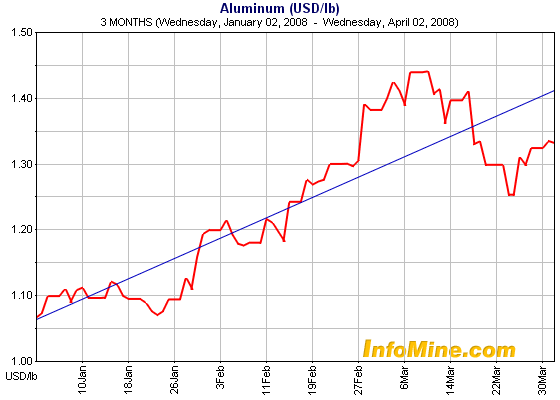
This morning Deutsche Bank analysts joined the chorus of those electing aluminium as the base metal of choice for 2008-09.
Deutsche also cites problems in South Africa and China. South Africa has been forced to reduce aluminium smelter capacity in light of its systemic power shortage problems, while over in China the National Reform & Development Commission has been busy trying to decelerate aluminium production growth for the same reason. The analysts estimate 500-600kt per year of production capacity has been shut down in 2008. The rate of production growth hit 35% in 2007, but had slowed to 9% by the end of February.
On the other side of the equation, even the Fed now thinks there could be a recession in the US. This should spread quickly to Japan, and eventually to Europe. However, while one might thus expect a subsequent reduction in demand for all industrial commodities, the reality is the OECD has represented only a small proportion of aluminium demand growth in recent times. Aluminium’s widest use is in the construction of cars, trucks and other vehicles, and the emerging world is now abandoning the bicycle in droves. Hence demand-side pressure will remain while production becomes more constrained. When the current aluminium surplus runs out, deficits will prevail. Deutsche notes it appears China was already importing aluminium by late 2007.
Deutsche recently increased its aluminium forecast prices by 7.6%, 12.9% and 15.5% in 2008-10, representing averages of US$1.30/lb, US$1.37/lb and US$1.27/lb.
Canada’s RBC Capital Markets is also marching to the same drummer, forecasting Chinese aluminium demand to grow by 25% in 2008 following the extraordinary 43% growth in 2007. RBC does not expect China to become a net importer until 2009 however, forecasting a 2008 surplus of 219,000t. Nevertheless, RBC then sees significant deficits for 2009-10, and suggests the 2008 surplus will place little downward pressure on prices as the world prepares itself for shortages.
RBC is forecasting prices of US$1.15/lb, US$1.25/lb and US$1.30/lb in 2008-10. Bear in mind that these are average prices, and that resource analysts always play the safe side by keeping their forecasts conservative given the valuation changes implicit for highly-leveraged listed producers.
Speaking of which…
We noted in the above feature in February that while BHP Billiton ((BHP)) and Rio Tinto ((RIO)) are Australia’s biggest producers of aluminium by a long way, the best pure-play on aluminium is provided by Alumina Ltd ((AWC)). Since the article was published, Alumina has traded from $5.00 to $6.50 and almost back to $5.00 again, with the last traded price $5.80.
Since early February Alumina has been granted three ratings upgrades on the basis of higher forecast aluminium prices, lifting its FNArena B/H/S ratio to 7/2/1. The sceptic is JP Morgan, who has yet to be convinced of the looming aluminium shortage and had felt the Alumina price had run too far. But JPM has been quiet since mid-February and has yet to undertake its quarterly commodity price updates. The FNArena average target price currently stands at $6.31.
Click to view our Glossary of Financial Terms
CHARTS
For more info SHARE ANALYSIS: BHP - BHP GROUP LIMITED

For more info SHARE ANALYSIS: RIO - RIO TINTO LIMITED