
Australia | Nov 17 2011

This story features NEWS CORPORATION, and other companies.
For more info SHARE ANALYSIS: NWS
The company is included in ASX200, ASX300 and ALL-ORDS
By Greg Peel
“Considerable risks in Europe certainly remain,” note the Deutsche Bank Australian equity strategists, “but with changes in key governments there may be progress from here”.
Deutsche Bank is not alone in this view. After the disastrous months of August and September, in which it looked like Greece may have to exit the euro, anticipation from early October of a definitive plan to save Europe saw global stock markets stage a significant bounce. While questions remained as to whether the plan to leverage the EFSF to E1trn went far enough, or whether the E106bn set aside for European bank recapitalisation went far enough, the world largely took the plan to be the first realistically positive step in the whole European debacle for two years.
Everything was going swimmingly until political issues reared their ugly head in Greece and suddenly Italy hit the spotlight as well. Political issues also became the focus in Italy and another period of market volatility ensued. But now that both Greece and Italy have settled on new technocrat governments, where are we left?
Well, judging by Wall Street's ridiculous response last night (the Dow fell 150 points in less than an hour) to a screamingly obvious assessment from rating agency Fitch that the US banking sector would be impacted were the European crisis not to be solved, we remain on the edge of a precipice and will jump off at the sign of any shadow.
However, those more inclined to dismiss intraday swings and roundabouts and look towards a longer term investment horizon, such as equity strategists, have become more inclined to think the European issue is now on a path to resolution. At the very least, strategists such as those at Deutsche feel that now is the time to start preparing for a new rush in the “risk on” trade.
Deutsche notes the recent run of economic data, particularly from the US and China, has been solid. In terms of data “surprises”, they've stopped being negative and started being a bit more neutral. In a similar sense, US corporate forecast earnings revisions have stopped leaning to the negative side and appear to have bottomed post the September quarter reporting season – an event which historically precedes a market bounce. And the gap between forecast market dividend yield and the benchmark bond yield has increased to near thirty-year peaks, suggesting attractive valuation.
Perhaps most importantly, investor positioning remains defensive, notes Deutsche, and may soon need to be unwound. Short stock positions are near record highs and hedge funds were well underexposed to equities at the end of the September quarter.
On the basis of all of the above, the Deutsche strategists have decided it's “time to take the leap” and move to a more bullish stance, having been conservatively positioned since August.
Deutsche has moved to Overweight on Australian resource stocks. Chinese growth remains solid and commodity prices have fallen further than industrial production numbers would suggest. Deutsche expects the reduction in the level of Chinese GDP growth to bottom either late 2011 or early 2012 and in the previous cycle commodity prices began to move up ahead of that bottom.
Deutsche retains its Overweight position on the banks, trimmed back a bit for outperformance to date. Valuation upside is less apparent than it was at the early October index nadir but earnings risk is low and yields are solid.
Deutsche is also trimming back positions in defensive stocks. The strategists continue to be Overweight on resource-exposed industrials but still feel RBA rate cuts are not enough to turn around domestic cyclicals. Consumer service sector stocks are preferred.
In terms of Deutsche's model portfolio, the strategists have added Oil Search ((OSH)), News Corp ((NWS)), AMP ((AMP)), Primary Healthcare ((PRY)) and Commonwealth Bank ((CBA)). They have removed AGL ((AGK)), ResMed ((RMD)), Sonic Healthcare ((SHL)), Wesfarmers ((WES)) and National Bank ((NAB)).
[It's probably a good point at which FNArena should again point out that “strategists” are top-down forecasters with unspecified investment horizons and may hold differing views to their “analyst” colleagues at the same broking house who are bottom-up forecasters mostly on a 12-month investment horizon.]
In terms of general market perception, Deutsche's strategists won't get much of an argument out of their peers at Goldman Sachs. In short, GS is looking towards a backdrop of a more accommodative policy emerging from Beijing as inflation pressures diminish – a view becoming increasingly widely held. And the GS team also acknowledges the underweight positions still being held by bearish investors in risk assets and cyclical stocks.
Over the past twelve months, notes Goldmans, China and emerging markets have consistently underperformed the US and developed markets providing little incentive for the resources sector to outperform. But on expectations of easing from Beijing as Chinese inflation eases, the GS strategists are now increasing resource sector exposure in their model portfolio. Weightings have been increased in Rio Tinto ((RIO)), BHP Billiton ((BHP)) and Sims Metal ((SGM)).
Out go Sonic Healthcare and Incitec Pivot ((IPL)) and after recent outperformance, National Bank ((NAB)) has also been trimmed.
Following the changes, the five largest Overweight positions in the Goldman Sachs model portfolio are NAB, Wesfarmers, News Corp, ANZ Bank ((ANZ)) and Orica ((ORI)). The five largest Underweight are Westpac ((WBC)), Telstra ((TLS)), Woolworths ((WOW)), Newcrest ((NCM)) and Westfield ((WDC)).
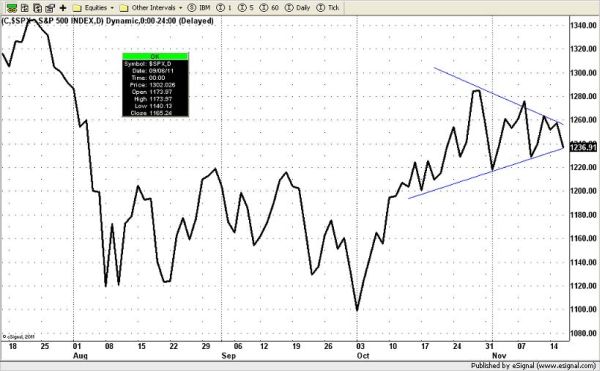
For those with a technical bent, observe this chart of the US S&P 500 index:
Source: eSignal
Respected trader Dennis Gartman notes the S&P has been anchored either side of 1250 for the past few weeks and the longer this consolidation takes place the more “violent”, suggests Gartman, the move upward will be when the consolidation ends. Why upward and not downward? This is a “classic” technical pattern and the rule is that once consolidation is broken the market will move in the same direction it was moving before the consolidation period.
Continuing on a technical bent, Daniel Goulding of The Sextant Market Letter sees a wave structure ahead that suggests a 15% rally in the ASX 200 in less than four weeks. His target for end-2011 is 4500 (trading 4235 as I write). The bad news, however, is that a psychological bottom has not yet been witnessed according to Goulding's measures which indicate a December bottom in the ASX 200 in the 3800-4000 range.
Which means we have to go down first before we can go up, but if Goulding's analysis proves prescient then a solid buying opportunity is still in front of us.
If you don't put a lot of faith in tea-leaf readers, look away now.
Despite Goulding's short term bullishness he remains of the view we are in a bear market, and based on market movements in the 1991-92 recession he sees the ASX 200 hitting 3018 sometime between September 2012 and March 2013.
Technical limitations
If you are reading this story through a third party distribution channel and you cannot see charts included, we apologise, but technical limitations are to blame.
Find out why FNArena subscribers like the service so much: "Your Feedback (Thank You)" – Warning this story contains unashamedly positive feedback on the service provided.
Click to view our Glossary of Financial Terms
CHARTS
For more info SHARE ANALYSIS: AMP - AMP LIMITED

For more info SHARE ANALYSIS: NAB - NATIONAL AUSTRALIA BANK LIMITED
For more info SHARE ANALYSIS: NWS - NEWS CORPORATION
For more info SHARE ANALYSIS: RIO - RIO TINTO LIMITED
For more info SHARE ANALYSIS: TLS - TELSTRA GROUP LIMITED
For more info SHARE ANALYSIS: WBC - WESTPAC BANKING CORPORATION
For more info SHARE ANALYSIS: WES - WESFARMERS LIMITED
For more info SHARE ANALYSIS: WOW - WOOLWORTHS GROUP LIMITED