
Commodities | Apr 30 2026

This story features PLS GROUP LIMITED, and other companies.
For more info SHARE ANALYSIS: PLS
The company is included in ASX50, ASX100, ASX200, ASX300 and ALL-ORDS
Persistent short positioning, even after a sharp rally, points to concerns about processing margins and where value is captured in the lithium market.
By Paul Githaiga
PLS Ltd ((PLS)), formerly known as Pilbara Minerals, has already seen the unwind of the obvious trade.
From early 2025 lows near $3.75 to around $6.00 as of late April 2026, the stock has rallied strongly. Lithium prices have stabilised after a steep correction. Operational delivery has been cleaner, with expansion projects completed and cost guidance re-affirmed.
One data series has not followed that recovery. This is where the tension emerges:
The company is profitable, cashed up, and still arguably one of the best operators in the sector. Yet, the short sellers have not fully thrown in the towel.
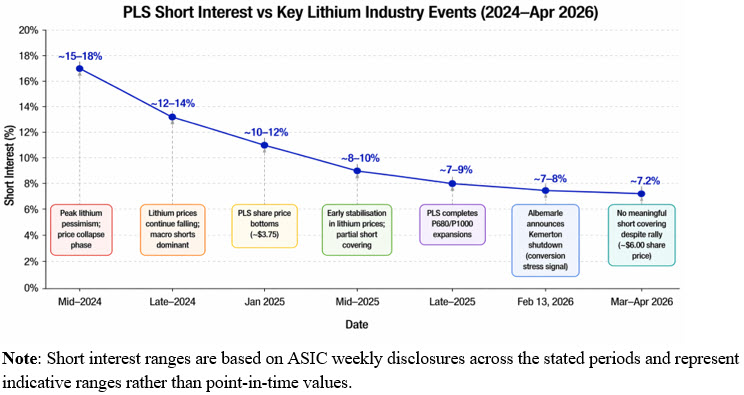
According to the latest short position data as published by ASIC, PLS remains shorted at approximately 6.8% of issued capital. That is materially below the 15–18% levels observed through 2024, but still places the stock among the most shorted large-cap names on the ASX.
Technical data confirm the intensity of this positioning, with ‘Days to Cover’ estimated at roughly 7.4 days based on recent average trading volumes.
This volume-weighted exposure suggests any material positive catalyst could trigger a violent short squeeze, as exiting these positions would require over a week of average trading volume.
The key point is not the level alone. It is what has happened since.
For the latest ASIC data on short positions in Australia:
https://fnarena.com/index.php/2026/04/30/the-short-report-30-apr-2026/
The First Proof: Shorts Have Not Covered Into a 60% Rally
Between early 2025 and April 2026:
-
Share price: rallied by circa 60%
-
Operational risk: reduced (projects completed)
-
Market narrative: shifted from collapse to stabilisation
Under typical market dynamics, that combination forces short covering.
Instead:
Short interest has stabilised around 7% for months rather than trending toward zero.
That is observable behaviour — not interpretation.
It demonstrates:
-
The original macro short (price collapse) has largely been reduced
-
A residual position remains held through improving conditions
In market terms, that indicates:
A shift from cyclical positioning to structural conviction
The Second Proof: Positioning Held Through a Major Industry Shock
On February 13, 2026, Albemarle announced it would halt operations at its Kemerton lithium hydroxide facility in Western Australia.
In its official statement, CEO Kent Masters said:
“The recent lithium price improvement alone is not enough to offset challenges facing Western hard rock lithium conversion operations.”
This is a primary-source, attributable statement from one of the world’s largest lithium producers.
From a market perspective, this was a decisive signal:
-
Not about demand
-
About conversion economics outside China
What happened next matters.
ASIC short-position data for the February–March 2026 period shows no material reduction in short positioning in PLS following the Kemerton announcement, despite a material industry signal on conversion economics.
That creates a direct causal link:
-
A real-world validation of processing challenges
-
Followed by no short covering response
This is not inferred intent. It is an observable positioning behaviour aligned with a specific industry event.
The Third Proof: The Pattern Extends Beyond Lithium
The Kemerton outcome is not isolated.
Across 2025–2026, multiple Australian processing operations have faced similar pressure:
-
Alcoa ((AAI)) curtailed refining operations at Kwinana
-
BHP Group ((BHP)) exited its Kalgoorlie nickel smelter after 50 years of operation
-
Simcoa reduced silicon production in February 2026, citing international competition
Each of these outcomes was:
-
Announced publicly
-
Attributed to cost competitiveness and global market pressure
The common factor is clear:
Processing assets in higher-cost jurisdictions are struggling to compete with lower-cost global supply chains.
The Structural Context: Where the Margin Sits
According to Climate Energy Finance (March 2026 report):
-
China accounts for approximately 60% of global lithium chemical processing capacity and roughly 70% of refining capacity
These figures are consistent with multiple industry datasets (IEA, Benchmark Mineral Intelligence ranges).
Industry forecasts from groups such as Fastmarkets and Benchmark Mineral Intelligence indicate lithium supply growth in 2026 is expected to meet or exceed demand growth, following a wave of project expansions and new supply.
Rather than rely on a single forecast figure, the consistent conclusion across sources is:
The market is not supply-constrained in the near term.
What This Means for PLS — And Why Shorts Remain
None of the above is specific to PLS’ operations.
That distinction matters.
PLS remains:
-
A low-cost spodumene producer
-
With completed expansion projects
-
And a strong balance sheet
From its December 2025 quarterly:
-
$1.61bn in cash and liquid assets
In April 2026:
-
The company issued US$600m in senior unsecured notes (6.875%, due 2031)
-
The deal was upsized, indicating strong institutional demand
Combined with existing reserves, this builds a total “war chest” approaching $2.5bn. This liquidity scale positions the company as a potential “last man consolidating” if higher-cost peers continue to falter and exit the market.
Management chose debt over equity dilution. That signals confidence in future cash flows to service the notes – a key data point the market may be underweighting.
On the operational front, PLS has already delivered what many miners only promise.
The P680 and P1000 expansion projects were completed on time and within budget during FY25. The P680 project delivered the world’s largest lithium ore sorter at Pilgangoora.
The P1000 project added approximately 320,000 tonnes per annum to nameplate capacity – a roughly 47% increase.
FY26 production guidance sits at 820,000-870,000 tonnes, with unit costs falling to $560-$600 per tonne, positioning PLS as a low-cost lithium producer.
Managing Director Dale Henderson noted: “With the P680 and P1000 expansions now complete, and our ore sorting technology fully integrated, we’ve established a leading processing platform.”
So, there is no evidence in the data that short sellers are targeting operational weakness.
Instead, the positioning reflects a deeper question:
At what point in the value chain are sustainable margins earned?
The Critical Distinction: Resource Ownership vs Margin Capture
The persistence of short interest —despite operational strength— indicates a specific market view:
-
Mining (spodumene production) is not the bottleneck
-
Processing and conversion are where economic constraints emerge
The Kemerton closure provides direct evidence of that constraint. China’s processing dominance reinforces it.
The lack of short covering following these developments connects the positioning to that thesis.
Where the Debate Still Sits
There is a clear counter-argument.
PLS’s joint venture with POSCO in South Korea provides:
-
A non-China processing pathway
-
Potential exposure to supply chains aligned with the US Inflation Reduction Act (IRA) requirements
Specifically, the joint venture targets FEOC-compliant offtake eligible for US subsidies.
If successful, this pathway allows the company to command a premium by bypassing the structural constraints embedded in existing global supply chains.
Then, the margin capture could shift.
However, as of April 2026, this remains a developing earnings stream, not yet a proven driver of group profitability.
What Will Decide the Trade
This debate can not be resolved on volume alone.
The key variables are:
-
Unit costs vs guidance ($560–600/t)
-
Realised pricing trends
-
Cash flow generation relative to new debt obligations
-
Evidence of higher-value offtake pathways
These are measurable, reportable outcomes — not narrative.
The Bottom Line
The thesis can now be stated —and supported— without assumption.
-
PLS remains heavily shorted (6.8% according to most recent ASIC data, April 2026)
-
Short positions have persisted through a circa 60% price recovery
-
No covering followed a major industry validation event (Kemerton shutdown, Feb 2026)
-
Processing margin pressure is observable across multiple operators and commodities
-
Industry data confirm structural concentration of value in downstream processing
Taken together, this forms a consistent, evidence-based conclusion:
The persistence and timing of short positioning is consistent with a market view that value capture in the lithium supply chain —particularly outside China— remains structurally constrained.
That is not a cyclical call. It is a structural one.
Final Investor Takeaways
-
Short interest persistence is signal, not lag
-
Industry events (like Kemerton) provide real-time validation points
-
The key risk is not production, but margin location
-
The decisive data will come from costs, pricing, and downstream returns — not announcements
Technical limitations
If you are reading this story through a third party distribution channel and you cannot see the chart included, we apologise, but technical limitations are to blame.
Find out why FNArena subscribers like the service so much: “Your Feedback (Thank You)” – Warning this story contains unashamedly positive feedback on the service provided.
FNArena is proud about its track record and past achievements: Ten Years On
Click to view our Glossary of Financial Terms
CHARTS
For more info SHARE ANALYSIS: AAI - ALCOA CORPORATION

For more info SHARE ANALYSIS: BHP - BHP GROUP LIMITED
For more info SHARE ANALYSIS: PLS - PLS GROUP LIMITED